Skip to content
dronacharya.ai
KVPY 2020ChemistrySingle correct+1 / -0.25

Chemistry, question 32

From KVPY 2020 · Stream SA

Among the following, the compounds which can exhibit optical activity are:

I: a 1,3-diphenylcyclobutane-2,4-dicarboxylic acid (Ph and CO₂H up on one pair of adjacent carbons, CO₂H and Ph down on the other pair); II: trans-1,2-diphenylcyclopropane; III: H2C=C=C(CH3)ClH_2C{=}C{=}C(CH_3)Cl; IV: HO2C−CH(OH)−CH(OH)−CH2OHHO_2C{-}CH(OH){-}CH(OH){-}CH_2OH (Fischer projection, both OH on the left); V: 3-methylhexane
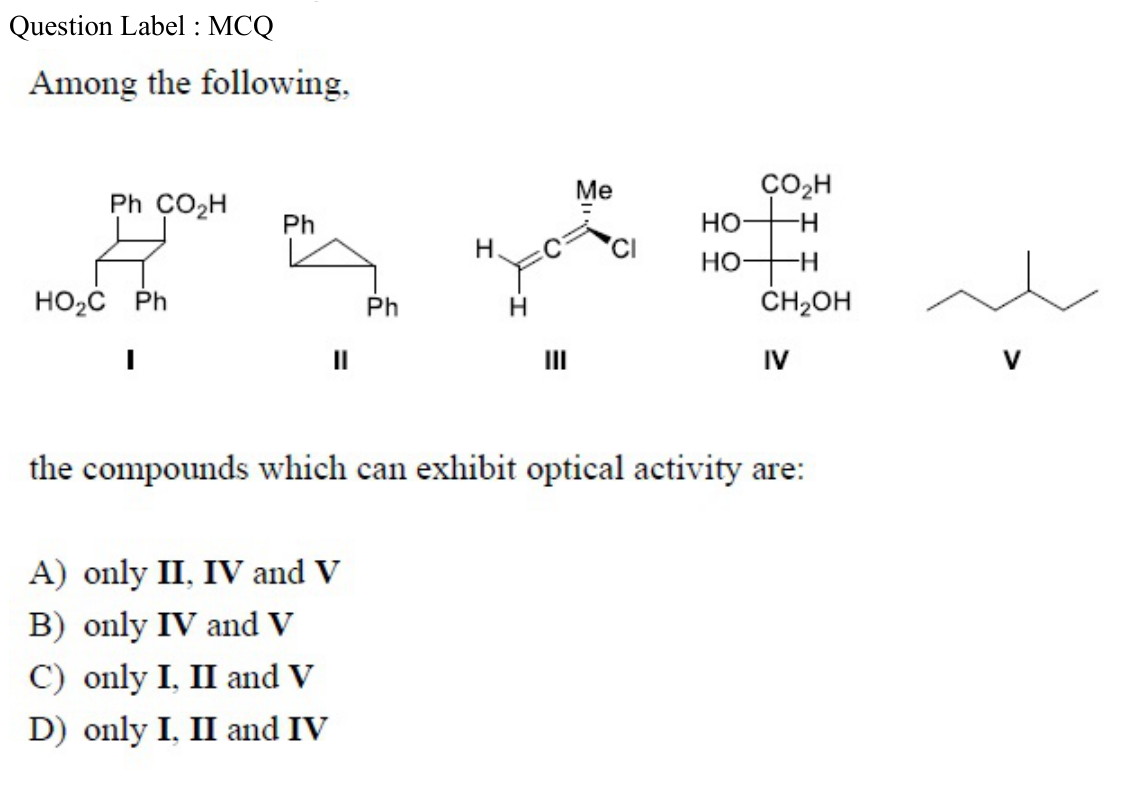
Five structures: I a cyclobutane with Ph and CO2H on alternate carbons (α-truxillic acid type); II trans-1,2-diphenylcyclopropane; III 1-chloro-1-methylallene drawn with wedges; IV a Fischer projection of 2,3,4-trihydroxybutanoic acid with both OH on the left; V the skeletal formula of 3-methylhexane.
Choose one option
Answer and worked solutionTry it first, then open this to check your working.
Official answerA

Worked solution

  • I has a centre of inversion (α-truxillic-acid type), so it is achiral.
  • II, trans-1,2-diphenylcyclopropane, has only a C2C_2 axis, so it is chiral.
  • III, H2C=C=C(Me)ClH_2C{=}C{=}C(Me)Cl, has two H on one terminal carbon, so the allene is achiral.
  • IV, 2,3,4-trihydroxybutanoic acid, has two different stereocentres, so it is chiral.
  • V, 3-methylhexane, has C-3 bearing H, CH3CH_3, C2H5C_2H_5 and C3H7C_3H_7, so it is chiral.

The optically active compounds are II, IV and V.

(A)

Practise this topic

Every past question tagged to the same part of the syllabus, with solutions.

full papers
153
questions
13,073
worked solutions
13,054

Sit a paper tonight. See exactly where you stand.

Timed, in the real format, and marked the moment you submit.