Skip to content
dronacharya.ai
KVPY 2018PhysicsSingle correct+2 / -0.5

Physics, question 97

From KVPY 2018 · Streams SB/SX

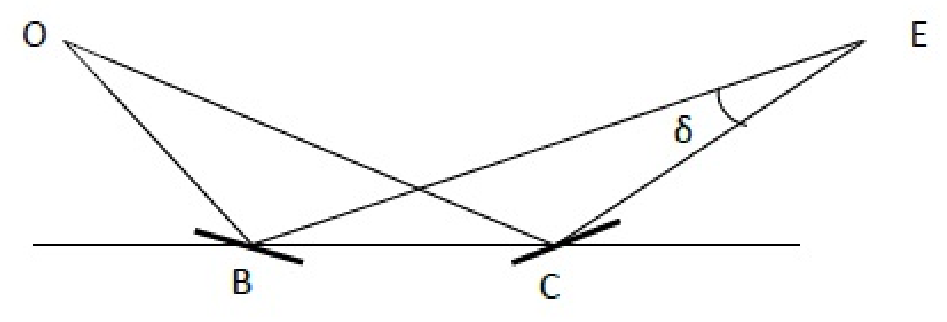
The image of an object OO due to reflection from the surface of a lake is elongated due to the ripples on the water surface caused by a light breeze. This is because the ripples act as tilted mirrors as shown. Consider the case where OO and the observer EE are at the same height above the surface of the lake. If the maximum angle that the ripples make with the horizontal is α\alpha, the angular extent δ\delta of the image will be

Object O and observer E at the same height above a horizontal lake surface. Rays from O reflect off two tilted ripple facets at B and C to reach E; δ is the angle at E between the two reflected rays.
Choose one option
Answer and worked solutionTry it first, then open this to check your working.
Official answerC

Worked solution

Let OO and EE be at height hh, a distance 2L2L apart, and let the light reflect at a point xx from the midpoint. For small angles the ray arrives from O at elevation θ1≈θ0(1−x/L)\theta_1 \approx \theta_0(1-x/L) and leaves for EE at elevation θ2≈θ0(1+x/L)\theta_2 \approx \theta_0(1+x/L), where θ0=h/L\theta_0 = h/L.

A facet tilted by β\beta makes θ2−θ1=2β\theta_2-\theta_1 = 2\beta, so θ0x/L=β\theta_0x/L = \beta and θ2=θ0+β\theta_2 = \theta_0+\beta. As β\beta ranges over [−α,α][-\alpha, \alpha], the direction of view at EE spans θ0±α\theta_0\pm\alpha: δ=2α\delta = 2\alpha.

(C)

Practise this topic

Every past question tagged to the same part of the syllabus, with solutions.

full papers
153
questions
13,073
worked solutions
13,054

Sit a paper tonight. See exactly where you stand.

Timed, in the real format, and marked the moment you submit.