Skip to content
dronacharya.ai
KVPY 2017PhysicsSingle correct+2 / -0.5

Physics, question 98

From KVPY 2017 · Streams SB/SX · 19 Nov

Back surface of a glass (refractive index nn and thickness tt) is polished to work as a mirror as shown below. A laser beam falls on it and is partially reflected and refracted at the air-glass interface and fully reflected at the mirror surface respectively. A pattern of discrete spots of light is observed on the screen.

The spacing between the spots on the screen will be
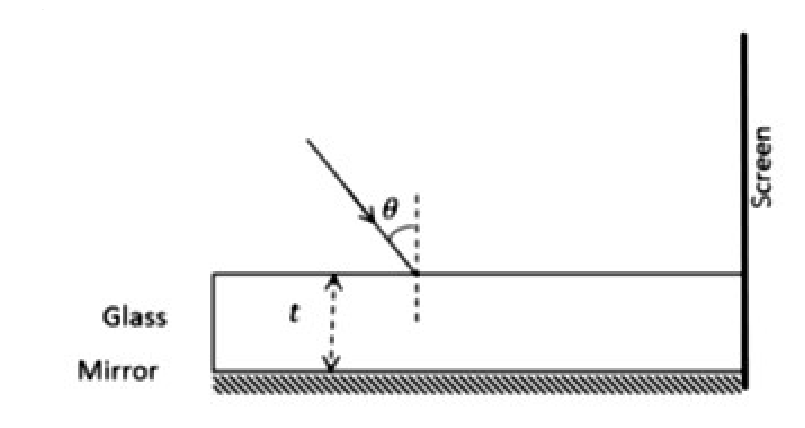
A glass slab of thickness $t$ with a mirror on its lower face; a laser beam strikes the top surface at angle $\theta$ to the normal; a vertical screen stands at the right edge of the slab.
Choose one option
Answer and worked solutionTry it first, then open this to check your working.
Official answerA

Worked solution

Inside, the beam travels at angle rr with sin⁡r=sin⁡θn\sin r = \frac{\sin\theta}n. Each round trip to the mirror shifts the emerging point along the surface by d=2ttan⁡rd = 2t\tan r, and all the emerging beams are parallel, at θ\theta to the vertical. On the vertical screen two beams a horizontal distance dd apart arrive a vertical distance d/tan⁡θd/\tan\theta apart:
2ttan⁡rtan⁡θ=2tsin⁡rcos⁡θcos⁡rsin⁡θ=2tcos⁡θncos⁡r=2tcos⁡θn2−sin⁡2θ.\frac{2t\tan r}{\tan\theta} = \frac{2t\sin r\cos\theta}{\cos r\sin\theta} = \frac{2t\cos\theta}{n\cos r} = \frac{2t\cos\theta}{\sqrt{n^2 - \sin^2\theta}}.

(A)

Practise this topic

Every past question tagged to the same part of the syllabus, with solutions.

full papers
153
questions
13,073
worked solutions
13,054

Sit a paper tonight. See exactly where you stand.

Timed, in the real format, and marked the moment you submit.