Skip to content
dronacharya.ai
KVPY 2017PhysicsSingle correct+1 / -0.25

Physics, question 25

From KVPY 2017 · Streams SB/SX · 19 Nov

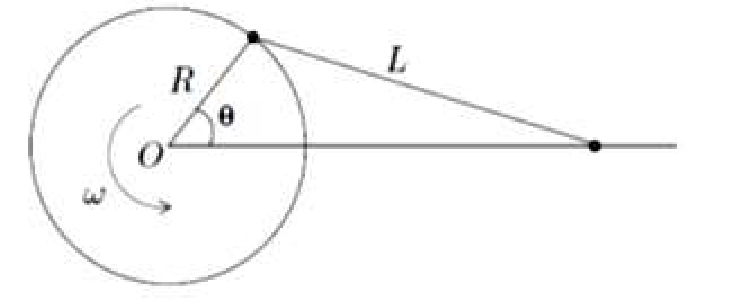
One end of a rod of length LL is fixed to a point on the circumference of a wheel of radius RR. The other end is sliding freely along a straight channel passing through the centre OO of the wheel as shown in the figure below. The wheel is rotating with a constant angular velocity ω\omega about OO. Taking T=2πωT = \dfrac{2\pi}\omega the motion of the rod is

A wheel of radius $R$ centred at $O$ turning with angular velocity $\omega$; a rod of length $L$ joins a point on the rim, at angle $\theta$ from the horizontal through $O$, to a point sliding along that horizontal line.
Choose one option
Answer and worked solutionTry it first, then open this to check your working.
Official answerC

Worked solution

The sliding end is at x=Rcos⁡ωt+L2−R2sin⁡2ωtx = R\cos\omega t + \sqrt{L^2 - R^2\sin^2\omega t}. This repeats when ωt\omega t increases by 2π2\pi, so the period is TT; but the square-root term adds harmonics (cos⁡2ωt\cos2\omega t, …), so the motion is not simple harmonic. Periodic with period TT, not SHM.

(C)

Practise this topic

Every past question tagged to the same part of the syllabus, with solutions.

full papers
153
questions
13,073
worked solutions
13,054

Sit a paper tonight. See exactly where you stand.

Timed, in the real format, and marked the moment you submit.