Skip to content
dronacharya.ai
KVPY 2017MathematicsSingle correct+1 / -0.25

Mathematics, question 1

From KVPY 2017 · Streams SB/SX · 19 Nov

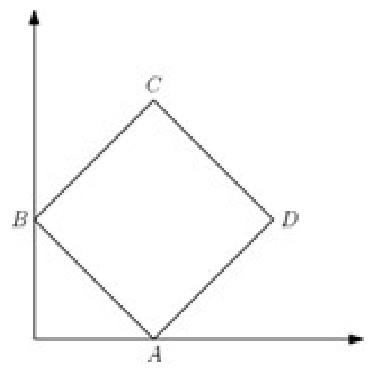
Consider a rigid square ABCDABCD as in the figure with AA and BB on the xx and yy axis respectively.

When AA and BB slide along their respective axes, the locus of CC forms a part of

A square ABCD standing on one corner: A on the positive $x$-axis, B on the positive $y$-axis, C above and D to the right.
Choose one option
Answer and worked solutionTry it first, then open this to check your working.
Official answerD

Worked solution

Let the side be ss, A=(scos⁡θ,0)A = (s\cos\theta, 0), B=(0,ssin⁡θ)B = (0, s\sin\theta). Going round the square, BC⃗\vec{BC} is AB⃗=(−scos⁡θ,ssin⁡θ)\vec{AB} = (-s\cos\theta, s\sin\theta) turned through 90∘90^\circ clockwise, i.e. (ssin⁡θ,scos⁡θ)(s\sin\theta, s\cos\theta). So C=(ssin⁡θ, ssin⁡θ+scos⁡θ)C = (s\sin\theta,\ s\sin\theta + s\cos\theta). With x=ssin⁡θx = s\sin\theta and y−x=scos⁡θy - x = s\cos\theta,
x2+(y−x)2=s2,i.e.2x2−2xy+y2=s2.x^2 + (y - x)^2 = s^2, \quad\text{i.e.}\quad 2x^2 - 2xy + y^2 = s^2.
This conic has discriminant (−2)2−4⋅2⋅1=−4<0(-2)^2 - 4\cdot2\cdot1 = -4 < 0 and an xyxy term, so it is an ellipse that is not a circle; CC traces part of it.

(D)

Practise this topic

Every past question tagged to the same part of the syllabus, with solutions.

full papers
153
questions
13,073
worked solutions
13,054

Sit a paper tonight. See exactly where you stand.

Timed, in the real format, and marked the moment you submit.