Skip to content
dronacharya.ai
KVPY 2017PhysicsSingle correct+2 / -0.5

Physics, question 68

From KVPY 2017 · Stream SA · 19 Nov

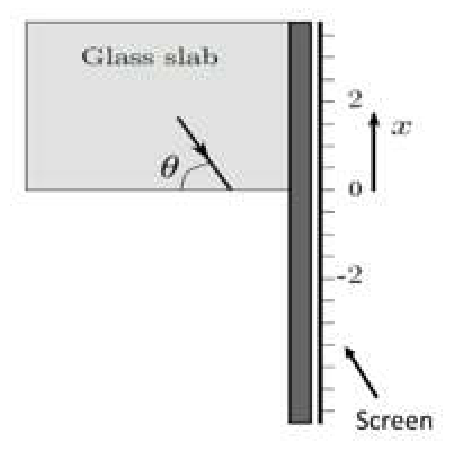
A ray of light originates from inside a glass slab and is incident on its inner surface at an angle θ\theta as shown,

In this experiment, the location xx of the spot where the ray hits the screen is recorded. Which of the following correctly shows the plot of variation of xx with the angle θ\theta?

A rectangular glass slab with a vertical screen (scale marked 2, 0, -2, x upward) along its right face. Inside the slab a ray travels down and to the right to the bottom surface, making angle θ with that surface; x = 0 is at the level of the bottom surface.
Choose one option
Answer and worked solutionTry it first, then open this to check your working.
Official answerA

Worked solution

Take x=0x = 0 at the level of the bottom face, where the ray meets it at angle θ\theta to the surface. The angle of incidence is i=90∘−θi = 90^\circ - \theta.

  • Small θ\theta (grazing, i>ici > i_c): the ray is totally reflected upward at angle θ\theta above the face and reaches the screen at height x=dtan⁡θx = d\tan\theta, where dd is the horizontal distance to the screen. xx starts at 0 and rises like tan⁡θ\tan\theta.
  • At θ=90∘−ic\theta = 90^\circ - i_c, total internal reflection stops. The ray now leaves through the bottom face, just grazing it, and meets the screen near x=0x = 0.
  • Larger θ\theta: the refraction angle rr (from the vertical) falls from 90∘90^\circ towards 0, so the ray hits the screen at x=−dcot⁡rx = -d\cot r, falling ever faster to large negative values as θ→90∘\theta \to 90^\circ.

So xx rises from 0, jumps back to 0 and then falls steeply: plot A.

(A)

Practise this topic

Every past question tagged to the same part of the syllabus, with solutions.

full papers
153
questions
13,073
worked solutions
13,054

Sit a paper tonight. See exactly where you stand.

Timed, in the real format, and marked the moment you submit.