Skip to content
dronacharya.ai
KVPY 2017PhysicsSingle correct+2 / -0.5

Physics, question 66

From KVPY 2017 · Stream SA · 19 Nov

Persons A and B are standing on the opposite sides of a 3.5 m wide water stream which they wish to cross. Each one of them has a rigid wooden plank whose mass can be neglected. However, each plank is only slightly longer than 3 m. So they decide to arrange them together as shown in the figure schematically. With B (mass 17 kg) standing, the maximum mass of A, who can walk over the plank is close to,
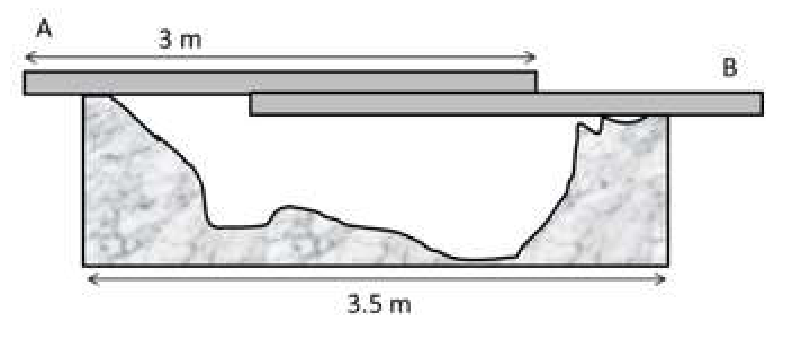
A 3.5 m wide stream between two banks. A's 3 m plank rests on the left bank and reaches out over the stream; B's plank lies below it, resting on the right bank where B stands at its far end, with its left end under the end of A's plank.
Choose one option
Answer and worked solutionTry it first, then open this to check your working.
Official answerC

Worked solution

B's plank rests on B's bank, with its edge as the fulcrum. B stands on the end over land, and the free end sticks out over the stream to carry the end of A's plank.

A's plank reaches only about 3 m from A's bank, so B's plank must overhang by at least x=3.5−3=0.5x = 3.5 - 3 = 0.5 m. That leaves at most about 3−0.5=2.53 - 0.5 = 2.5 m of it on land, where B stands.

The worst case is A at the tip of B's plank. Taking moments about the bank edge:
mA x=17 (3−x)⇒mA=17×2.50.5=85 kg.m_A\,x = 17\,(3 - x) \Rightarrow m_A = \frac{17 \times 2.5}{0.5} = 85\ \text{kg}.

The planks are only slightly longer than 3 m and must overlap a little, so the limit is a little below this: close to 80 kg.

(C)

Practise this topic

Every past question tagged to the same part of the syllabus, with solutions.

full papers
153
questions
13,073
worked solutions
13,054

Sit a paper tonight. See exactly where you stand.

Timed, in the real format, and marked the moment you submit.