Skip to content
dronacharya.ai
KVPY 2017PhysicsSingle correct+1 / -0.25

Physics, question 29

From KVPY 2017 · Stream SA · 19 Nov

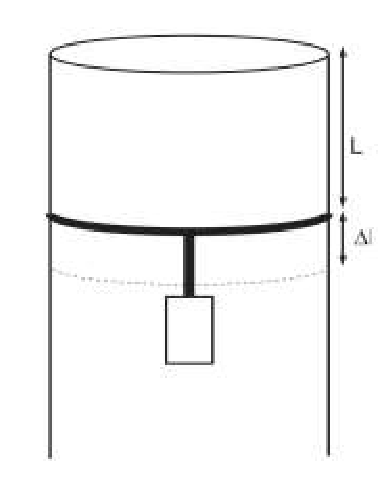
A long cylindrical pipe of radius 20 cm is closed at its upper end and has an airtight piston of negligible mass as shown. When a 50 kg mass is attached to the other end of piston, it moves down by a distance Δl\Delta l before coming to equilibrium. Assuming air to be an ideal gas, Δl/L\Delta l/L (see figure) is close to (g=10 m/s2g = 10\ \mathrm{m/s^2}, atmospheric pressure is 10510^5 Pascal),

Vertical cylinder closed at the top with a massless piston at depth L below the top; a block hangs from the piston by a rod, and the piston's downward displacement is marked Δl.
Choose one option
Answer and worked solutionTry it first, then open this to check your working.
Official answerC

Worked solution

The piston is massless, so the air starts at P0P_0 with length LL. In equilibrium with the mass,
P=P0−mgA,mgA=500π(0.2)2≈3979 Pa.P = P_0 - \frac{mg}{A},\qquad \frac{mg}{A} = \frac{500}{\pi(0.2)^2} \approx 3979\ \text{Pa}.

At constant temperature (Boyle's law), P0L=P(L+Δl)P_0L = P(L + \Delta l):
ΔlL=P0−PP=3979100000−3979≈0.041.\frac{\Delta l}{L} = \frac{P_0 - P}{P} = \frac{3979}{100000 - 3979} \approx 0.041.

(C)

Practise this topic

Every past question tagged to the same part of the syllabus, with solutions.

full papers
153
questions
13,073
worked solutions
13,054

Sit a paper tonight. See exactly where you stand.

Timed, in the real format, and marked the moment you submit.