Skip to content
dronacharya.ai
KVPY 2017PhysicsSingle correct+1 / -0.25

Physics, question 34

From KVPY 2017 · Streams SB/SX

On a pulley of mass MM hangs a rope with two masses m1m_1 and m2m_2 (m1>m2m_1 > m_2) tied at the ends as shown in the figure. The pulley rotates without any friction, whereas the friction between the rope and the pulley is large enough to prevent any slipping. Which of the following plots best represents the difference between the tensions in the rope on the two sides of the pulley as a function of the mass of the pulley?
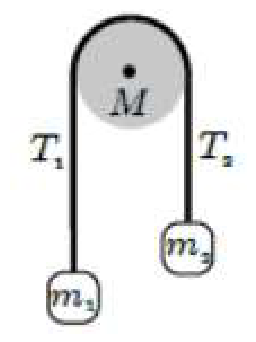
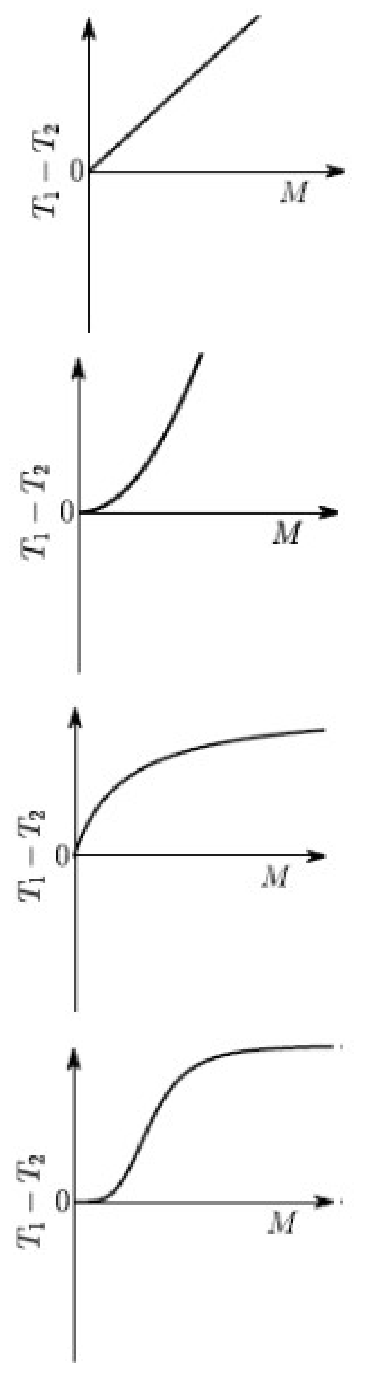
A pulley of mass $M$ with a rope over it: mass $m_1$ hangs on the left with tension $T_1$, mass $m_2$ on the right with tension $T_2$.The four options stacked vertically, $T_1 - T_2$ against $M$: (A) a straight line from the origin; (B) a curve bending upward; (C) a curve rising and levelling off; (D) an S-shaped rise to a plateau.
Choose one option
Answer and worked solutionTry it first, then open this to check your working.
Official answerC

Worked solution

For a disc pulley of radius RR, (T1−T2)R=12MR2α(T_1 - T_2)R = \frac12MR^2\alpha with a=αRa = \alpha R, so T1−T2=12MaT_1 - T_2 = \frac12Ma. The masses give (m1−m2)g−(T1−T2)=(m1+m2)a(m_1 - m_2)g - (T_1 - T_2) = (m_1 + m_2)a, so a=(m1−m2)gm1+m2+M/2a = \dfrac{(m_1-m_2)g}{m_1 + m_2 + M/2} and
T1−T2=12M(m1−m2)gm1+m2+12M.T_1 - T_2 = \frac{\frac12M(m_1 - m_2)g}{m_1 + m_2 + \frac12M}.
This is zero at M=0M = 0, rises with a finite slope and levels off towards (m1−m2)g(m_1 - m_2)g: plot (C).

(C)

Practise this topic

Every past question tagged to the same part of the syllabus, with solutions.

full papers
153
questions
13,073
worked solutions
13,054

Sit a paper tonight. See exactly where you stand.

Timed, in the real format, and marked the moment you submit.