Skip to content
dronacharya.ai
KVPY 2017PhysicsSingle correct+2 / -0.5

Physics, question 100

From KVPY 2017 · Streams SB/SX

A star of mass MM (equal to the solar mass) with a planet (much smaller than the star) revolves around the star in a circular orbit. The velocity of the star with respect to the center of mass of the star-planet system is shown below:

The radius of the planet's orbit is closest to (1 A.U. = Earth-Sun distance)
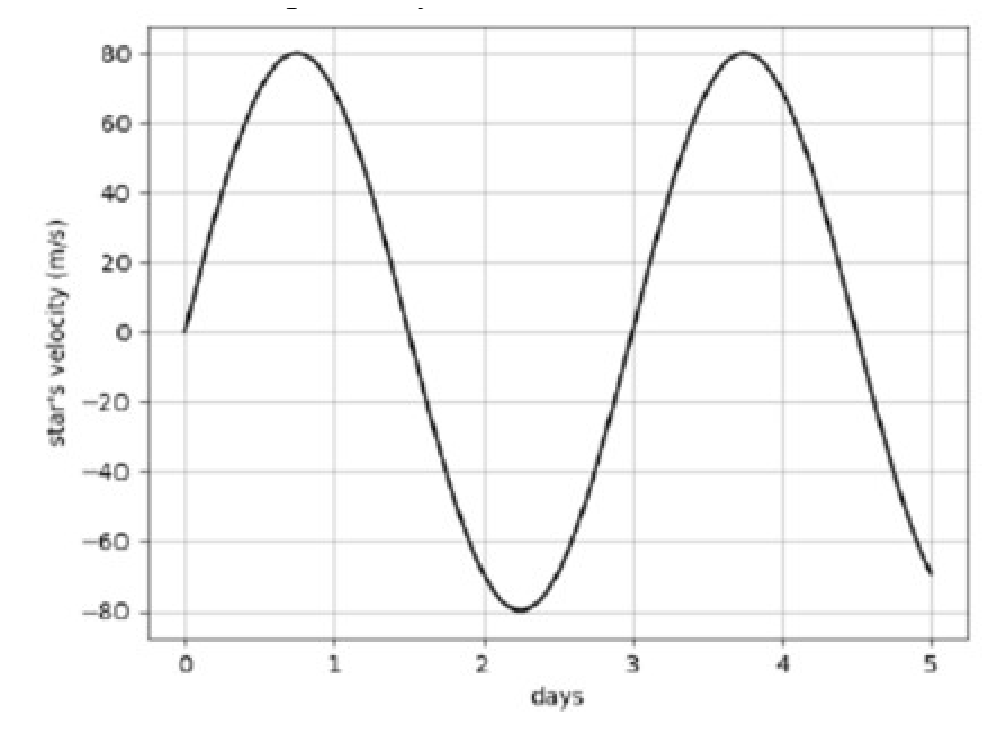
The star's velocity (m/s) against time (days) from 0 to 5: a sine wave of amplitude 80 m/s, with peaks near 0.75 and 3.75 days and a trough near 2.25 days.
Choose one option
Answer and worked solutionTry it first, then open this to check your working.
Official answerC

Worked solution

The velocity repeats every 3 days (peaks at about 0.75 and 3.75 days), so the planet's period is T=3T = 3 days =8.2×10−3= 8.2\times10^{-3} yr. For a solar-mass star Kepler's third law in A.U. and years is a3=T2a^3 = T^2, so a=(8.2×10⁻³)2/3≈0.041a = (8.2\times10^{-3})^{2/3} \approx 0.041 A.U.

(C)

Practise this topic

Every past question tagged to the same part of the syllabus, with solutions.

full papers
153
questions
13,073
worked solutions
13,054

Sit a paper tonight. See exactly where you stand.

Timed, in the real format, and marked the moment you submit.