Skip to content
dronacharya.ai
KVPY 2017PhysicsSingle correct+1 / -0.25

Physics, question 25

From KVPY 2017 · Stream SA

The word "KVPY" is written on a board and viewed through different lenses such that board is at a distance beyond the focal length of the lens.

Ignoring magnification effects, consider the following statements.

(I) Image (i) has been viewed from the planar side of a plano-convex lens and image (ii) from the convex side of a plano-convex lens.

(II) Image (i) has been viewed from the concave side of a plano-concave lens and image (ii) from the convex side of a plano-convex lens.

(III) Image (i) has been viewed from the concave side of a plano-concave lens and image (ii) from the planar side of a plano-convex lens.

(IV) Image (i) has been viewed from the planar side of a plano-concave lens and image (ii) from the convex side of a plano-convex lens.

Which of the above statements are correct?
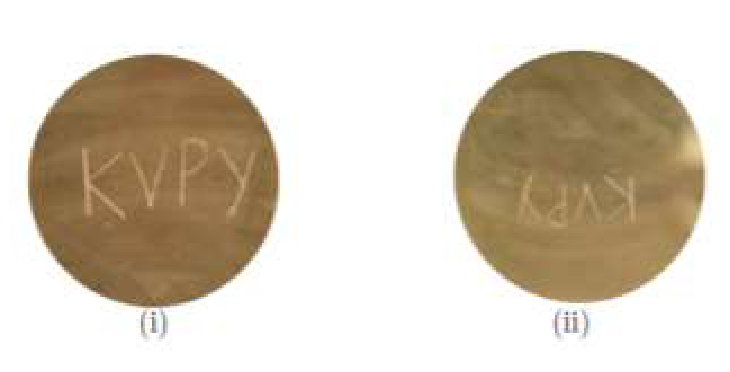
Two photographs of the word KVPY seen through lenses: (i) the word appears upright and readable; (ii) the word appears rotated by 180 degrees (upside down and reversed).
Choose one option
Answer and worked solutionTry it first, then open this to check your working.
Official answerD

Worked solution

With the object beyond the focal length:

  • a converging (plano-convex) lens forms a real, inverted image, so the word appears upside down and reversed, as in (ii);
  • a diverging (plano-concave) lens always forms a virtual, erect image, so the word appears upright, as in (i).

The focal length of a thin lens does not depend on which face points at the object.

  • (I) puts image (i) through a plano-convex lens. False.
  • (II), (III) and (IV) all have (i) through a plano-concave lens and (ii) through a plano-convex lens. True.

(D)

Practise this topic

Every past question tagged to the same part of the syllabus, with solutions.

full papers
153
questions
13,073
worked solutions
13,054

Sit a paper tonight. See exactly where you stand.

Timed, in the real format, and marked the moment you submit.