Skip to content
dronacharya.ai
KVPY 2016PhysicsSingle correct+1 / -0.25

Physics, question 26

From KVPY 2016 · Streams SB/SX

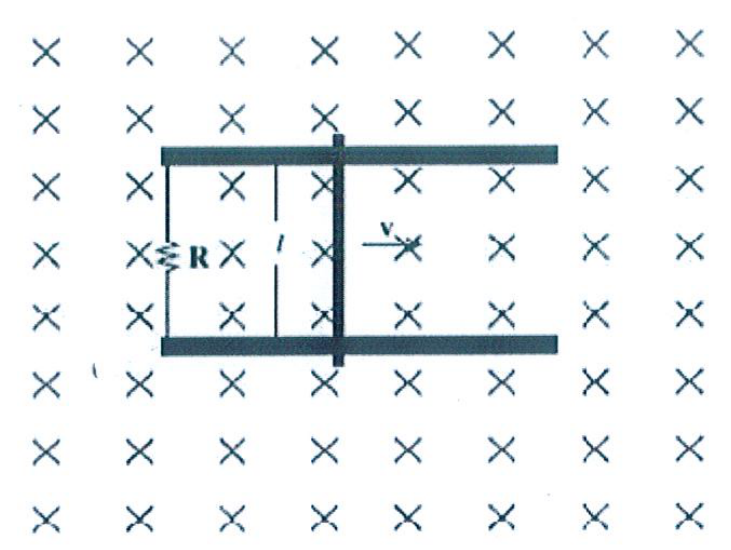
A conducting bar of mass mm and length ll moves on two frictionless parallel rails in the presence of a constant uniform magnetic field of magnitude BB directed into the page as shown in the figure. The bar is given an initial velocity v0v_0 towards the right at t=0t = 0. Then the

Two horizontal parallel rails joined at the left end through a resistor R; a vertical conducting bar of length l rests across the rails and moves to the right with velocity v. A uniform magnetic field into the page (crosses) fills the region.
Choose one option
Answer and worked solutionTry it first, then open this to check your working.
Official answerC

Worked solution

The emf is BlvBlv and the current is I=BlvRI = \dfrac{Blv}{R}. The magnetic force on the bar opposes the motion:
mdvdt=−B2l2Rv.m\frac{dv}{dt} = -\frac{B^2l^2}{R}v.

  • The speed decays exponentially, not linearly (B is wrong).
  • Writing m dv=−B2l2R dxm\,dv = -\frac{B^2l^2}{R}\,dx, the total distance is x=mv0RB2l2x = \dfrac{mv_0R}{B^2l^2}, proportional to RR (C is right).
  • The power B2l2v2R\dfrac{B^2l^2v^2}{R} goes as l2l^2, not ll (D is wrong).
  • The flux into the page grows as the bar moves right, so the induced current is anticlockwise (A is wrong).

(C)

Practise this topic

Every past question tagged to the same part of the syllabus, with solutions.

full papers
153
questions
13,073
worked solutions
13,054

Sit a paper tonight. See exactly where you stand.

Timed, in the real format, and marked the moment you submit.