Skip to content
dronacharya.ai
KVPY 2016MathematicsSingle correct+2 / -0.5

Mathematics, question 64

From KVPY 2016 · Stream SA

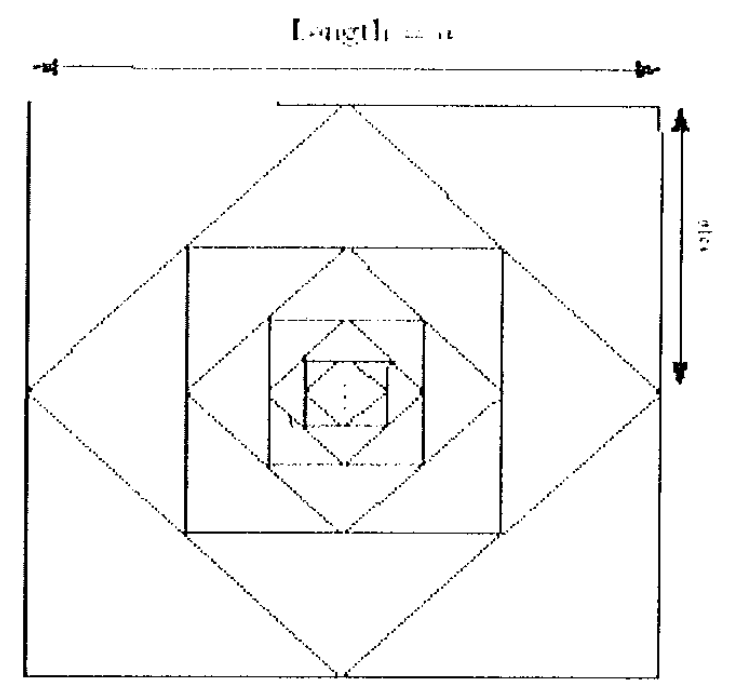
Let S1S_1 be the sum of areas of the squares whose sides are parallel to coordinate axes. Let S2S_2 be the sum of areas of the slanted squares as shown in the figure. Then S1/S2S_1/S_2 is

Nested squares: an outer axis-parallel square of side a; inside it a slanted square (rotated 45°) with vertices at the midpoints of its sides; inside that an axis-parallel square with vertices at the midpoints of the slanted square's sides, and so on indefinitely. The side a is marked 'Length = a' above, and the next square's side is marked a/√2.
Choose one option
Answer and worked solutionTry it first, then open this to check your working.
Official answerA

Worked solution

Joining the midpoints of a square's sides gives a square with half the area. So the areas alternate between axis-parallel and slanted squares:
a2, a22, a24, a28, …a^2,\ \tfrac{a^2}{2},\ \tfrac{a^2}{4},\ \tfrac{a^2}{8},\ \dots

  • Axis-parallel squares: S1=a2(1+14+116+… )=43a2S_1 = a^2\left(1 + \tfrac14 + \tfrac1{16} + \dots\right) = \tfrac43a^2
  • Slanted squares: S2=a22(1+14+… )=23a2S_2 = \tfrac{a^2}{2}\left(1 + \tfrac14 + \dots\right) = \tfrac23a^2

So S1S2=2\frac{S_1}{S_2} = 2.

(A)

Practise this topic

Every past question tagged to the same part of the syllabus, with solutions.

full papers
153
questions
13,073
worked solutions
13,054

Sit a paper tonight. See exactly where you stand.

Timed, in the real format, and marked the moment you submit.