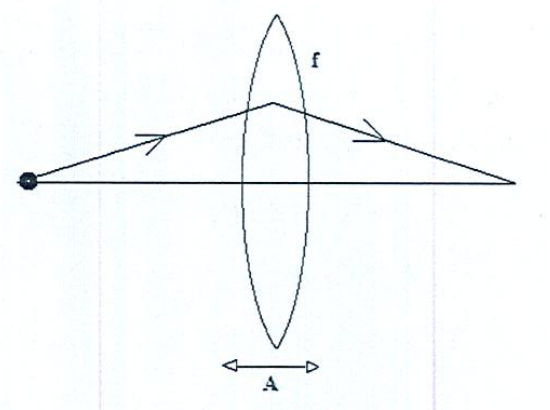
A point object is placed 20 cm left of a convex lens of focal length cm (see the figure). The lens is made to oscillate with small amplitude along the horizontal axis. The image of the object will also oscillate along the axis with
From KVPY 2015 · Stream SA
A point object is placed 20 cm left of a convex lens of focal length cm (see the figure). The lens is made to oscillate with small amplitude along the horizontal axis. The image of the object will also oscillate along the axis with
Worked solution
With cm and cm:
The magnification is , so the longitudinal magnification is .
Suppose the lens moves a small distance to the right:
Relative to the lens, the image oscillates with amplitude , moving opposite to the lens's displacement: out of phase.
(Measured from the ground, the image moves , in phase with the lens. No option offers that, so the options evidently intend motion relative to the lens.)
(A)
Every past question tagged to the same part of the syllabus, with solutions.
Timed, in the real format, and marked the moment you submit.