Skip to content
dronacharya.ai
KVPY 2014ChemistrySingle correct+1 / -0.25

Chemistry, question 48

From KVPY 2014 · Streams SB/SX

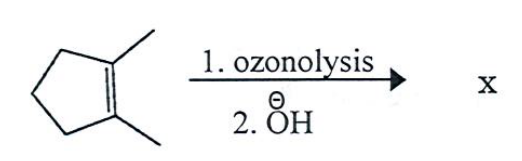
In the following reaction, 1,2-dimethylcyclopentene →1. ozonolysis; 2. OH−\xrightarrow{\text{1. ozonolysis; 2. OH}^-} X, the major product X is

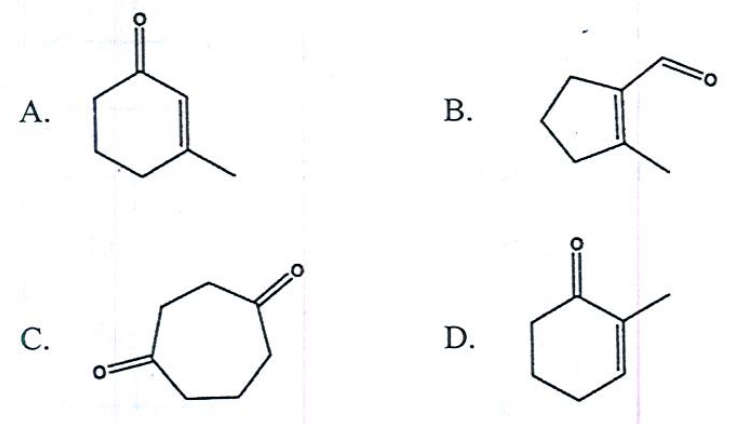
1,2-Dimethylcyclopentene, with 1. ozonolysis, 2. OH⁻, gives X.Four options. A: cyclohexenone with the C=O at C1 and a methyl on C3 of the C2=C3 double bond (3-methylcyclohex-2-en-1-one). B: a cyclopentene carrying a CHO and a methyl on the two double-bond carbons. C: a seven-membered ring with two C=O groups. D: cyclohexenone with the methyl on C2 (2-methylcyclohex-2-en-1-one).
Choose one option
Answer and worked solutionTry it first, then open this to check your working.
Official answerA

Worked solution

Step 1: ozonolysis.
Cleaving the CX1=CX2\ce{C1=C2} bond of 1,2-dimethylcyclopentene opens the ring and turns both alkene carbons into carbonyls, giving the straight-chain diketone

CHX3−CO−CHX2−CHX2−CHX2−CO−CHX3(heptane-2,6-dione).\ce{CH3-CO-CH2-CH2-CH2-CO-CH3} \quad \text{(heptane-2,6-dione)}.

Step 2: intramolecular aldol.
Hydroxide generates the enolate at a terminal methyl, which attacks the far carbonyl. Closing onto that carbon gives a six-membered ring (favoured over the alternative four-membered closure); dehydration of the β\beta-hydroxy ketone then gives the conjugated enone

3-methylcyclohex-2-en-1-one.\text{3-methylcyclohex-2-en-1-one}.

(A)

Practise this topic

Every past question tagged to the same part of the syllabus, with solutions.

full papers
153
questions
13,073
worked solutions
13,054

Sit a paper tonight. See exactly where you stand.

Timed, in the real format, and marked the moment you submit.