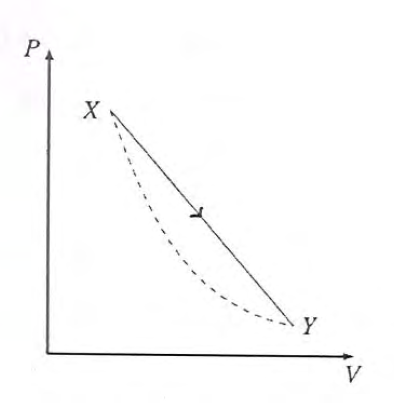
Compare the chord with the adiabat. Both paths start at X and end at Y on the same adiabat. Since the adiabat is convex (it sags below the chord), the straight line XY lies above the adiabat everywhere between them.
What that means for temperature. Along the adiabat T falls steadily from X to Y. At any intermediate volume the straight line has a higher pressure than the adiabat, hence (at the same V) a higher temperature. So along XY the temperature starts at TX, rises above the adiabatic value, and must come back down to TY: it rises then falls, with a maximum at some point Z.
Apply the first law. dQ=nCVdT+PdV. On the first stretch both dT>0 and dV>0, so dQ>0: heat is absorbed. Past Z the temperature falls, and beyond a certain point the negative nCVdT outweighs the positive PdV, so dQ<0: heat is released. (Strictly dQ changes sign where dT/dV=−P/nCV; for the straight-line process this single crossing is the point Z referred to.)
(C)