Skip to content
dronacharya.ai
KVPY 2013PhysicsSingle correct+1 / -0.25

Physics, question 26

From KVPY 2013 · Streams SB/SX

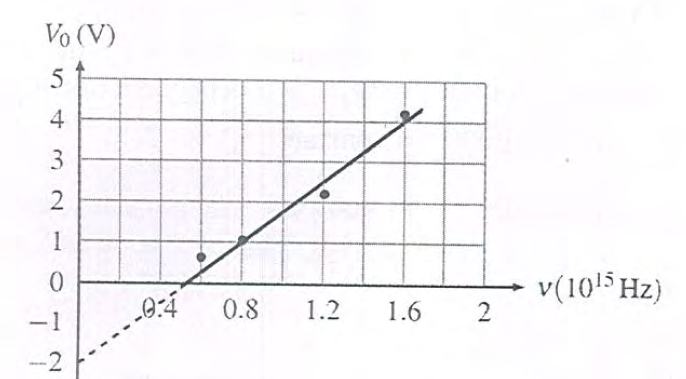
In a photocell circuit the stopping potential, V0V_0, is a measure of the maximum kinetic energy of the photoelectrons. The following graph shows experimentally measured values of stopping potential versus frequency ν\nu of incident light.

The values of Planck's constant and the work function as determined from the graph are (taking the magnitude of electronic charge to be e=1.6×10⁻¹⁹e = 1.6\times10^{-19} C)

Stopping potential V0 in volts (vertical axis, ruled from -2 to 5) against frequency in units of 10^15 Hz (horizontal axis, marked 0.4, 0.8, 1.2, 1.6, 2). Four measured points lie on a rising straight line; the fitted line is extended by a dashed segment to cut the vertical axis at about -2 V and the frequency axis at about 0.5 x 10^15 Hz.
Choose one option
Answer and worked solutionTry it first, then open this to check your working.
Official answerB

Worked solution

Einstein's photoelectric equation.
eV0=hν−ϕ  ⟹  V0=heν−ϕe,eV_0 = h\nu - \phi \;\Longrightarrow\; V_0 = \frac he\nu - \frac\phi e ,
so the graph is a straight line of slope h/eh/e with intercept −ϕ/e-\phi/e.

Read the intercept. The dashed extension meets the V0V_0 axis at about −2-2 V, so
ϕe=2 V  ⟹  ϕ=2.0 eV.\frac\phi e = 2\ \text{V} \;\Longrightarrow\; \phi = 2.0\ \text{eV}.

Read the slope. The line crosses V0=0V_0 = 0 at the threshold ν0≈0.53×10¹⁵\nu_0 \approx 0.53\times10^{15} Hz, so
he=2 V0.53×1015 Hz≈3.8×10⁻¹⁵ V s,\frac he = \frac{2\ \text{V}}{0.53\times10^{15}\ \text{Hz}} \approx 3.8\times10^{-15}\ \text{V s},
h≈3.8×10−15×1.6×10−19≈6.0×10⁻³⁴ J s.h \approx 3.8\times10^{-15}\times 1.6\times10^{-19} \approx 6.0\times10^{-34}\ \text{J s}.

(B)

Practise this topic

Every past question tagged to the same part of the syllabus, with solutions.

full papers
153
questions
13,073
worked solutions
13,054

Sit a paper tonight. See exactly where you stand.

Timed, in the real format, and marked the moment you submit.