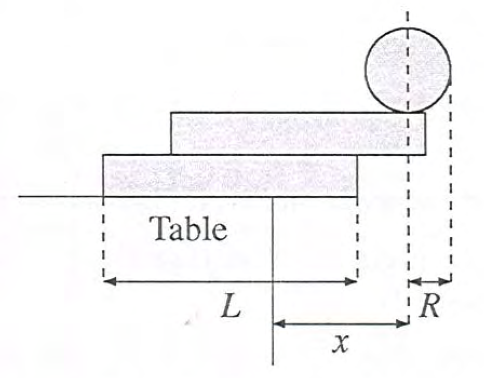
Set up coordinates. Measure x horizontally outward from the table's vertical edge. Let the upper block occupy [x−L, x], so its centre is at x−L/2 and the sphere's centre sits at x (directly above the block's outer end). Let the lower block's outer end be at b, so its centre is at b−L/2.
Condition 1: the upper block and sphere must not topple over the lower block's edge at b. Their combined centre of mass must not pass b:
M+2MM(x−2L)+2Mx≤b⟹2323x−2L≤b⟹x−3L≤b.
Condition 2: the whole stack must not topple over the table edge at 0.
M(b−2L)+M(x−2L)+2Mx≤0⟹b+23x−L≤0⟹b≤L−23x.
Combine.
x−3L≤b≤L−23x⟹x−3L≤L−23x⟹25x≤34L⟹x≤158L.
So xmax=8L/15 (with b=8L/15−L/3=L/5). Note R does not enter: the sphere's weight acts through its centre, whose horizontal position is x whatever the radius.
(A)