Skip to content
dronacharya.ai
KVPY 2013PhysicsSingle correct+1 / -0.25

Physics, question 25

From KVPY 2013 · Stream SA

The figure shows a bar magnet and a metallic coil. Consider four situations.

(I) Moving the magnet away from the coil.

(II) Moving the coil towards the magnet.

(III) Rotating the coil about the vertical diameter.

(IV) Rotating the coil about its axis.

An emf in the coil will be generated for the following situations.
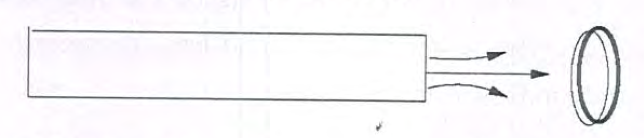
A horizontal bar magnet on the left; to its right, a circular coil standing vertically with its plane perpendicular to the magnet's axis, so the axis of the magnet passes through the centre of the coil. Arrows between them point in both directions along the axis.
Choose one option
Answer and worked solutionTry it first, then open this to check your working.
Official answerC

Worked solution

Faraday's law needs the flux Φ=B⃗⋅A⃗\Phi = \vec B \cdot \vec A through the coil to change.

  • (I) Magnet moved away: the field at the coil weakens, Φ\Phi falls. emf.
  • (II) Coil moved towards the magnet: the field at the coil strengthens, Φ\Phi rises. emf. (Only relative motion matters.)
  • (III) Coil rotated about a vertical diameter: the coil's normal, initially along the magnet's axis, tilts away from B⃗\vec B, so Φ=BAcos⁡θ\Phi = BA\cos\theta changes. emf.
  • (IV) Coil rotated about its own axis: the axis is already along B⃗\vec B. The coil simply spins in its own plane; its area, its orientation relative to B⃗\vec B and hence Φ\Phi are all unchanged. No emf.

So (I), (II) and (III) only.

(C)

Practise this topic

Every past question tagged to the same part of the syllabus, with solutions.

full papers
153
questions
13,073
worked solutions
13,054

Sit a paper tonight. See exactly where you stand.

Timed, in the real format, and marked the moment you submit.