Skip to content
dronacharya.ai
KVPY 2012PhysicsSingle correct+2 / -0.5

Physics, question 99

From KVPY 2012 · Streams SB/SX

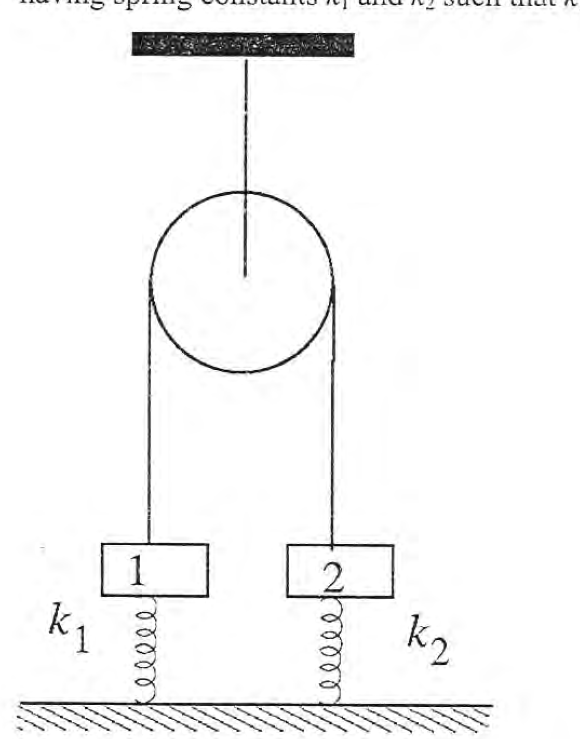
Two blocks (1 and 2) of equal mass mm are connected by an ideal string (see figure below) over a frictionless pulley. The blocks are attached to the ground by springs having spring constants k1k_1 and k2k_2 such that k1>k2k_1 > k_2.

Initially, both springs are unstretched. The block 1 is slowly pulled down a distance xx and released. Just after the release the possible values of the magnitudes of the accelerations of the blocks a1a_1 and a2a_2 can be

A pulley hangs from a rigid support with a string over it; a block labelled 1 hangs from the left end and a block labelled 2 from the right end. Each block is also joined to the ground below by a spring, the left one of constant k_1 and the right one of constant k_2, both standing on a hatched floor.
Choose one option
Answer and worked solutionTry it first, then open this to check your working.
Official answerA

Worked solution

While the string stays taut both blocks move together with the same acceleration. Pulling block 1 down by xx stretches spring 1 by xx and spring 2 by xx (block 2 having risen by xx), and both spring forces drive the system back:
a1=a2=(k1+k2)x2m.a_1 = a_2 = \frac{(k_1 + k_2)x}{2m}.

If the string goes slack (which it can, since k1>k2k_1 > k_2 means the two blocks are pulled back unequally), each block is on its own:
a1=k1xm−g  (spring 1 up, weight down),a2=k2xm+g  (spring 2 down, weight down).a_1 = \frac{k_1x}{m} - g\ \ (\text{spring 1 up, weight down}),\qquad a_2 = \frac{k_2x}{m} + g\ \ (\text{spring 2 down, weight down}).

Both cases are possible, which is what option (A) states.

(A)

Practise this topic

Every past question tagged to the same part of the syllabus, with solutions.

full papers
153
questions
13,073
worked solutions
13,054

Sit a paper tonight. See exactly where you stand.

Timed, in the real format, and marked the moment you submit.