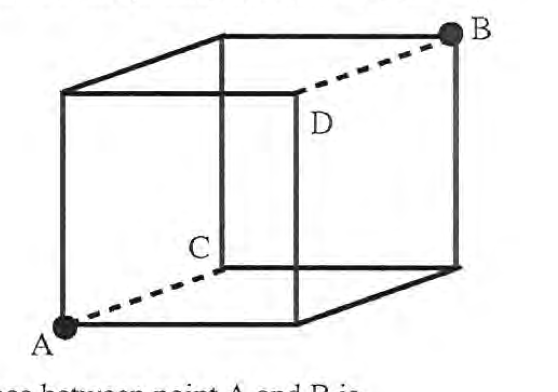
As shown in the figure below, a cube is formed with ten identical resistances (thick lines) and two shorting wires (dotted lines) along the arms AC and BD.
Resistance between point A and B is
From KVPY 2012 · Streams SB/SX
As shown in the figure below, a cube is formed with ten identical resistances (thick lines) and two shorting wires (dotted lines) along the arms AC and BD.
Resistance between point A and B is
Worked solution
Use the shorts. The wire along AC makes A and C one node, call it P; the wire along BD makes B and D one node, Q. A and B are at opposite ends of a body diagonal.
What is left. Of the twelve arms, two are the shorts; the other ten resistors connect the four remaining corners. Labelling the corners as binary triples with , , , , the ten resistors run
Two identical bridges. The network splits into two halves, and , each a Wheatstone bridge between P and Q: both nodes of a half join P through one and Q through one , and the two are joined to each other by a further .
By symmetry the two nodes of each half sit at the same potential, so the middle resistor carries no current. Each half is then two parallel paths of :
The two halves are in parallel:
(A)
Every past question tagged to the same part of the syllabus, with solutions.
Timed, in the real format, and marked the moment you submit.