Skip to content
dronacharya.ai
KVPY 2012PhysicsSingle correct+1 / -0.25

Physics, question 28

From KVPY 2012 · Streams SB/SX

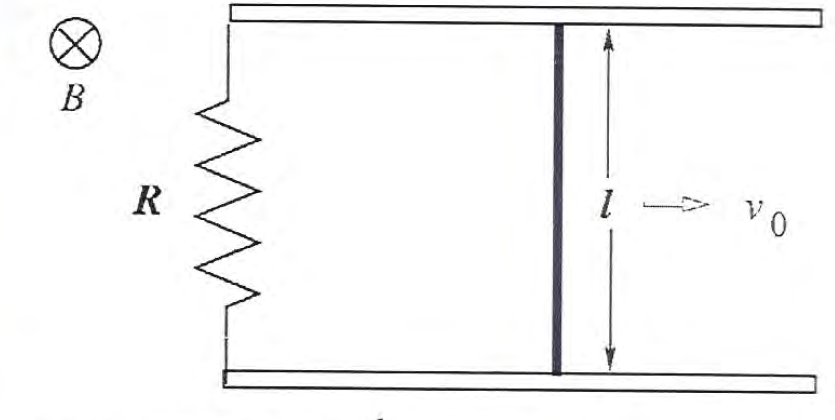
A conducting rod of mass mm and length ll is free to move without friction on two parallel long conducting rails, as shown below. There is a resistance RR across the rails. In the entire space around, there is a uniform magnetic field BB normal to the plane of the rod and rails. The rod is given an impulsive velocity v0v_0.

Finally, the initial energy 12mv02\dfrac12 mv_0^2

Two long horizontal rails joined at the left by a resistor R; a vertical conducting rod of length l lies across them and is given a velocity v_0 to the right. A circled cross on the left marks the uniform magnetic field B into the plane of the rails.
Choose one option
Answer and worked solutionTry it first, then open this to check your working.
Official answerA

Worked solution

The moving rod generates an emf BlvBlv, which drives a current through RR; the magnetic force on that current opposes the motion, so the rod slows and finally stops.

A magnetic force does no net work, and the rails are frictionless, so the only place the energy can go is the resistor:
∫i2R dt=12mv02.\int i^2R\,dt = \frac12 mv_0^2.

(A)

Practise this topic

Every past question tagged to the same part of the syllabus, with solutions.

full papers
153
questions
13,073
worked solutions
13,054

Sit a paper tonight. See exactly where you stand.

Timed, in the real format, and marked the moment you submit.