Skip to content
dronacharya.ai
KVPY 2012PhysicsSingle correct+2 / -0.5

Physics, question 68

From KVPY 2012 · Stream SA

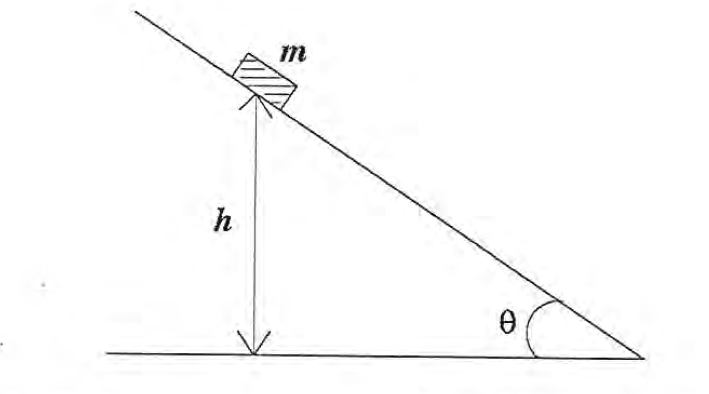
A block of mass mm is sliding down an inclined plane with constant speed. At a certain instant tot_o, its height above the ground is hh. The coefficient of kinetic friction between the block and the plane is μ\mu. If the block reaches the ground at a later instant tgt_g, then the energy dissipated by friction in the time interval (tg−to)(t_g - t_o) is

A right-angled triangle representing an inclined plane rising to the left, with the horizontal ground at the bottom and the base angle at the right marked theta. A small hatched block labelled m sits on the slope, and a vertical arrow labelled h runs from the block down to the ground, marking its height above the ground.
Choose one option
Answer and worked solutionTry it first, then open this to check your working.
Official answerB

Worked solution

The block slides at constant speed, so its kinetic energy does not change over (tg−to)(t_g - t_o).

By the work-energy theorem the total work is zero:
Wgravity+Wfriction=0⇒mgh+Wfriction=0.W_{\text{gravity}} + W_{\text{friction}} = 0 \Rightarrow mgh + W_{\text{friction}} = 0.

So friction dissipates
∣Wfriction∣=mgh.|W_{\text{friction}}| = mgh.

(The μ\mu is a red herring: constant speed already fixes μ=tan⁡θ\mu = \tan\theta, and μmgh/sin⁡θ⋅sin⁡θ\mu mgh/\sin\theta \cdot \sin\theta collapses back to mghmgh.)

(B)

Practise this topic

Every past question tagged to the same part of the syllabus, with solutions.

full papers
153
questions
13,073
worked solutions
13,054

Sit a paper tonight. See exactly where you stand.

Timed, in the real format, and marked the moment you submit.