Skip to content
dronacharya.ai
KVPY 2012PhysicsSingle correct+1 / -0.25

Physics, question 24

From KVPY 2012 · Stream SA

Following figures show different combinations of identical bulb(s) connected to identical battery(ies). Which option is correct regarding the total power dissipated in the circuit?
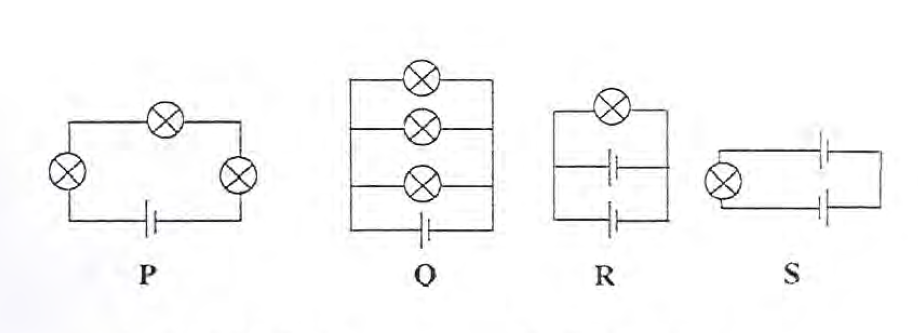
Four circuits drawn side by side and labelled P, Q, R and S. P is a single loop with three identical bulbs in series (one on the left side, one along the top, one on the right side) and a single cell in the bottom branch. Q has three identical bulbs on three parallel branches between the same two rails, with one cell in the bottom branch. R has one bulb in the top branch and two identical cells on two separate parallel branches below it. S has one bulb on the left side and two identical cells, one in the upper branch and one in the lower branch, so that the two cells drive the single bulb in series around the loop.
Choose one option
Answer and worked solutionTry it first, then open this to check your working.
Official answerD

Worked solution

Let each bulb have resistance RR and each cell emf VV.

  • P: three bulbs in series across one cell: PP=V23RP_P = \dfrac{V^2}{3R}.
  • Q: three bulbs in parallel across one cell: PQ=3V2RP_Q = \dfrac{3V^2}{R}.
  • R: one bulb across two cells in parallel: the emf is still VV: PR=V2RP_R = \dfrac{V^2}{R}.
  • S: one bulb driven by two cells in series: the emf is 2V2V: PS=4V2RP_S = \dfrac{4V^2}{R}.

So
V23R<V2R<3V2R<4V2R⇒P<R<Q<S.\frac{V^2}{3R} < \frac{V^2}{R} < \frac{3V^2}{R} < \frac{4V^2}{R} \Rightarrow P < R < Q < S.

(D)

Practise this topic

Every past question tagged to the same part of the syllabus, with solutions.

full papers
153
questions
13,073
worked solutions
13,054

Sit a paper tonight. See exactly where you stand.

Timed, in the real format, and marked the moment you submit.