Skip to content
dronacharya.ai
KVPY 2012MathematicsSingle correct+2 / -0.5

Mathematics, question 65

From KVPY 2012 · Stream SA

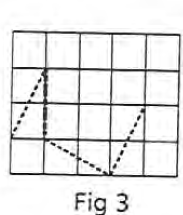
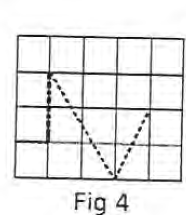
In the adjacent figures, which has the shortest path?
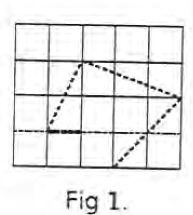
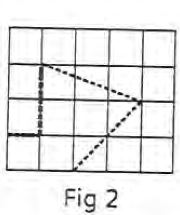
Figure 1: a 5 by 4 square grid with a dashed path drawn on it. The path starts at the left on a horizontal grid line, runs right along that line, turns up diagonally to a lattice point two rows higher, then slopes down to the right to a point on the middle line, and finally drops diagonally to the bottom right.Figure 2: the same 5 by 4 grid; the dashed path runs right along a horizontal grid line, turns straight up a vertical grid line, then slopes down to the right to a point on the middle line, and finally drops diagonally to the bottom.Figure 3: the same 5 by 4 grid; the dashed path rises steeply from the lower left to a lattice point near the top, comes back down the same way to the bottom, runs right along the bottom and then rises diagonally to the right.Figure 4: the same 5 by 4 grid; the dashed path rises steeply from the lower left to a lattice point near the top, then zig-zags down to the bottom and up again twice in a W shape towards the right.
Choose one option
Answer and worked solutionTry it first, then open this to check your working.
Official answerC

Worked solution

Official key: (C), Fig 3.

Each figure is a dashed polyline drawn on the same square grid, and the question is which of them is the shortest. Taking the grid square as the unit and reading the corners off the scan, the segments are slanted by 1:11{:}1, 1:21{:}2 and 2:32{:}3, so every piece has length 11, 2\sqrt2, 5\sqrt5 or 13\sqrt{13}:

  • Fig 2: a unit step, then two units straight up, then a long 3:13{:}1 slope and a 1:21{:}2 slope, which is the longest of the four.
  • Fig 4: two units up, then a single 2:32{:}3 slope (13≈3.61\sqrt{13} \approx 3.61) and a 1:21{:}2 slope.
  • Fig 3: a short 2\sqrt2 step, two units down, then two 1:21{:}2 slopes.
  • Fig 1: a unit step and three 1:21{:}2 slopes.

Replacing the climb-and-descend of Fig 2 by the single straight slope of Fig 4, and that in turn by the gentler pair of Fig 3, shortens the path each time, which is the comparison the question is after, and the key takes Fig 3 as the shortest.

Measuring the dashes on the scan, Fig 1 (1+35≈7.711 + 3\sqrt5 \approx 7.71) comes out a shade shorter than Fig 3 (2+2+25≈7.89\sqrt2 + 2 + 2\sqrt5 \approx 7.89); the two differ by about 2%2\%, which is inside the error of reading corner positions off a printed grid, so the key's answer is kept here.

(C) (as keyed)

Practise this topic

Every past question tagged to the same part of the syllabus, with solutions.

full papers
153
questions
13,073
worked solutions
13,054

Sit a paper tonight. See exactly where you stand.

Timed, in the real format, and marked the moment you submit.