Skip to content
dronacharya.ai
KVPY 2011PhysicsSingle correct+2 / -0.5

Physics, question 99

From KVPY 2011 · Streams SB/SX

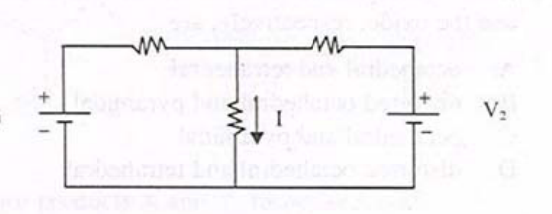
Two batteries V1V_1 and V2V_2 are connected to three resistors as shown below.

If V1=2V_1 = 2 V and V2=0V_2 = 0 V, the current I=3I = 3 mA. If V1=0V_1 = 0 V and V2=4V_2 = 4 V, the current I=4I = 4 mA. Now, if V1=10V_1 = 10 V and V2=10V_2 = 10 V, the current II will be

A circuit with battery V1 on the left branch and battery V2 on the right branch, both with their positive terminals at the top. The top wire runs from V1 through a resistor to a central node and on through a second resistor to V2. A third resistor runs from the central node down to the common bottom wire, and the current through it, directed downwards, is labelled I.
Choose one option
Answer and worked solutionTry it first, then open this to check your working.
Official answerD

Worked solution

The circuit is linear, so the sources superpose.
With V1=2V_1 = 2 V alone, I=3I = 3 mA, so V1V_1 contributes 1.51.5 mA per volt. With V2=4V_2 = 4 V alone, I=4I = 4 mA, so V2V_2 contributes 11 mA per volt. Both drive the current downward through the middle resistor, as the measurements show.

Both at 1010 V.
I=10(1.5)+10(1)=15+10=25 mA.I = 10(1.5) + 10(1) = 15 + 10 = 25\ \mathrm{mA}.

(D)

Practise this topic

Every past question tagged to the same part of the syllabus, with solutions.

full papers
153
questions
13,073
worked solutions
13,054

Sit a paper tonight. See exactly where you stand.

Timed, in the real format, and marked the moment you submit.