Skip to content
dronacharya.ai
KVPY 2011PhysicsSingle correct+2 / -0.5

Physics, question 95

From KVPY 2011 · Streams SB/SX

A constant amount of an ideal gas undergoes the cyclic process ABCA in the PV diagram shown below.

The path BC is an isothermal. The work done by the gas during one complete cycle, beginning and ending at A, is nearly
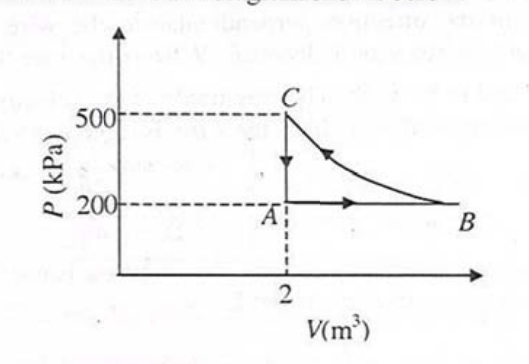
A pressure-volume diagram with P in kPa on the vertical axis, marked at 200 and 500, and V in cubic metres on the horizontal axis, marked at 2. Point A sits at 200 kPa and 2 cubic metres, point C directly above it at 500 kPa, and point B to the right of A at 200 kPa. An arrow runs from A rightwards to B, a curved isothermal runs from B back up and left to C, and a vertical arrow runs from C down to A.
Choose one option
Answer and worked solutionTry it first, then open this to check your working.
Official answerC

Worked solution

Find VBV_B.
A=(2 m3, 200 kPa)A = (2\ \mathrm{m^3},\,200\ \mathrm{kPa}) and C=(2 m3, 500 kPa)C = (2\ \mathrm{m^3},\,500\ \mathrm{kPa}). BB lies on the isotherm through CC at 200200 kPa:
PCVC=PBVB⟹VB=500×2200=5 m3.P_CV_C = P_BV_B \Longrightarrow V_B = \frac{500\times2}{200} = 5\ \mathrm{m^3}.

Leg by leg.

  • A→BA\to B at constant 200200 kPa: W=200 kPa×3 m3=+600W = 200\ \mathrm{kPa}\times 3\ \mathrm{m^3} = +600 kJ.
  • B→CB\to C isothermal: W=PBVBln⁡VCVB=1000ln⁡(0.4)=−916W = P_BV_B\ln\dfrac{V_C}{V_B} = 1000\ln(0.4) = -916 kJ.
  • C→AC\to A at constant volume: W=0W = 0.

Wcycle=600−916=−316 kJ≈−300 kJ.W_{\text{cycle}} = 600 - 916 = -316\ \mathrm{kJ} \approx -300\ \mathrm{kJ}.

(The cycle runs anticlockwise, so the work done by the gas is negative.)

(C)

Practise this topic

Every past question tagged to the same part of the syllabus, with solutions.

full papers
153
questions
13,073
worked solutions
13,054

Sit a paper tonight. See exactly where you stand.

Timed, in the real format, and marked the moment you submit.