Skip to content
dronacharya.ai
KVPY 2011PhysicsSingle correct+1 / -0.25

Physics, question 36

From KVPY 2011 · Streams SB/SX

Given below are three schematic graphs of potential energy V(r)V(r) versus distance rr for three atomic particles: electron (e−e^-), proton (p+p^+) and neutron (nn), in the presence of a nucleus at the origin O. The radius of the nucleus is r0r_0. The scale on the VV-axis may not be the same for all figures. The correct pairing of each graph with the corresponding atomic particle is
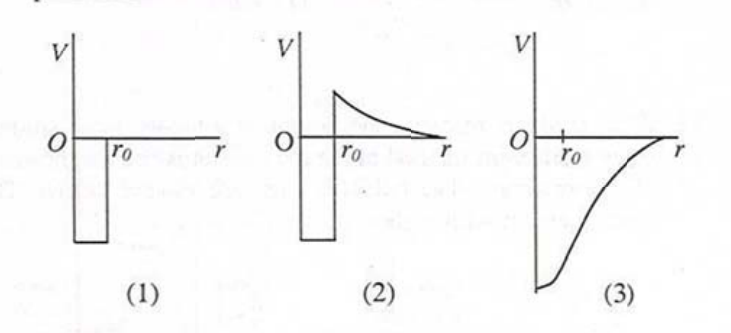
Three sketch graphs of potential energy V against distance r from a nucleus at the origin O, labelled (1), (2) and (3), each marking r0 on the r-axis. In (1) the curve is a square well: V is zero outside r0 and drops to a constant negative value inside, returning to zero along the axis. In (2) there is the same negative square well inside r0, but outside r0 the curve jumps to a positive value at r0 and decays towards zero as r grows. In (3) V is deeply negative just outside the origin and rises towards zero from below as r increases, approaching the axis asymptotically.
Choose one option
Answer and worked solutionTry it first, then open this to check your working.
Official answerA

Worked solution

What each particle feels.

  • A neutron feels only the short-range nuclear attraction: a square well inside r0r_0 and nothing outside: graph (1).
  • A proton feels the same well inside, plus the repulsive Coulomb barrier outside, positive at r0r_0 and decaying as 1/r1/r: graph (2).
  • An electron feels no nuclear force, only Coulomb attraction: VV is large and negative near the nucleus and rises towards zero: graph (3).

So the pairing is (1,n)(1,n), (2,p+)(2,p^+), (3,e−)(3,e^-).

(A)

Practise this topic

Every past question tagged to the same part of the syllabus, with solutions.

full papers
153
questions
13,073
worked solutions
13,054

Sit a paper tonight. See exactly where you stand.

Timed, in the real format, and marked the moment you submit.