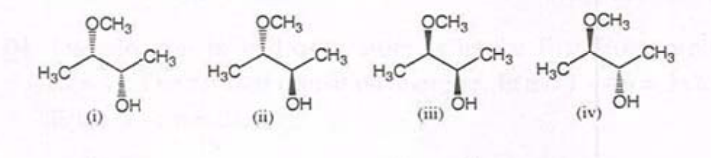
Optically active (S)--methoxyacetaldehyde on reaction with MeMgX gave a mixture of alcohols. The major diastereomer 'P' on treatment with gave an optically inactive compound. P is
From KVPY 2011 · Streams SB/SX
Optically active (S)--methoxyacetaldehyde on reaction with MeMgX gave a mixture of alcohols. The major diastereomer 'P' on treatment with gave an optically inactive compound. P is
Worked solution
What the two steps do.
adds a methyl to the aldehyde, creating a second stereocentre and giving the two diastereomers of 3-methoxybutan-2-ol. Methylation of the free with touches no stereocentre and gives 2,3-dimethoxybutane.
Which diastereomer loses its activity.
2,3-Dimethoxybutane has two identical stereocentres, so the form is meso and optically inactive, while and are chiral. So must be the diastereomer whose two centres are of opposite sense, the one drawn as (ii), with the original centre retained.
(B)
Every past question tagged to the same part of the syllabus, with solutions.
Timed, in the real format, and marked the moment you submit.