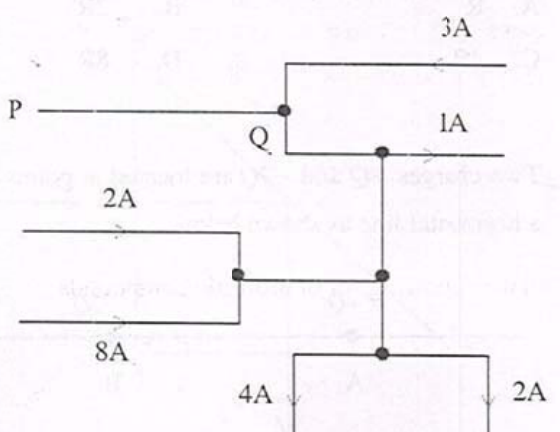
Figure below shows a portion of an electric circuit with the currents in amperes and their directions. The magnitude and direction of the current in the portion PQ is
From KVPY 2011 · Stream SA
Figure below shows a portion of an electric circuit with the currents in amperes and their directions. The magnitude and direction of the current in the portion PQ is
Worked solution
Treat the drawn portion as one junction and apply Kirchhoff's current rule to it as a whole: everything flowing in must flow out, and the wire PQ carries whatever is left over.
Read the arrowheads.
| branch | arrow | current |
|---|---|---|
| top right, 3 A | points left, into the network | in |
| right, 1 A | points right, out | out |
| left, 2 A | points right, in | in |
| left, 8 A | points right, in | in |
| bottom, 4 A and 2 A | point down, out | out |
Balance.
The surplus of A has nowhere to go but the wire PQ, and it must leave the network there:
(D)
Every past question tagged to the same part of the syllabus, with solutions.
Timed, in the real format, and marked the moment you submit.