Skip to content
dronacharya.ai
KVPY 2011PhysicsSingle correct+1 / -0.25

Physics, question 26

From KVPY 2011 · Stream SA

Two charges +Q+Q and −2Q-2Q are located at points A and B on a horizontal line as shown below.

The electric field is zero at a point which is located at a finite distance
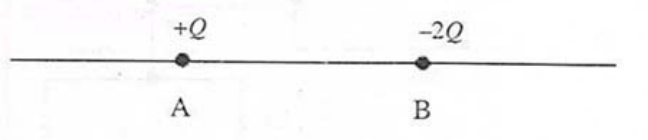
A long horizontal line with two marked points on it: A, carrying the charge +Q, on the left, and B, carrying the charge -2Q, to its right. Each charge is drawn as a dot with its label above and the point name below.
Choose one option
Answer and worked solutionTry it first, then open this to check your working.
Official answerB

Worked solution

Where can the fields cancel? The two charges have opposite signs and unequal magnitudes, so:

  • Between A and B both fields point the same way (away from +Q+Q, towards −2Q-2Q), so they add: never zero.
  • Outside, the two fields oppose, so a null point exists: but only where the smaller charge is closer, since the bigger charge must be further away to be weakened enough.

Which side? ∣−2Q∣>∣+Q∣|{-2Q}| > |{+Q}|, so the null point must be nearer +Q+Q, i.e. on the far side of A, left of A.

Check it is at a finite distance. With A at the origin, B at dd and the point at −x-x,
Qx2=2Q(x+d)2  ⟹  (x+d)2=2x2  ⟹  x=d2−1=d(2+1),\frac{Q}{x^2} = \frac{2Q}{(x+d)^2} \;\Longrightarrow\; (x+d)^2 = 2x^2 \;\Longrightarrow\; x = \frac{d}{\sqrt2 - 1} = d(\sqrt2+1),
a finite distance to the left of A.

(B)

Practise this topic

Every past question tagged to the same part of the syllabus, with solutions.

full papers
153
questions
13,073
worked solutions
13,054

Sit a paper tonight. See exactly where you stand.

Timed, in the real format, and marked the moment you submit.