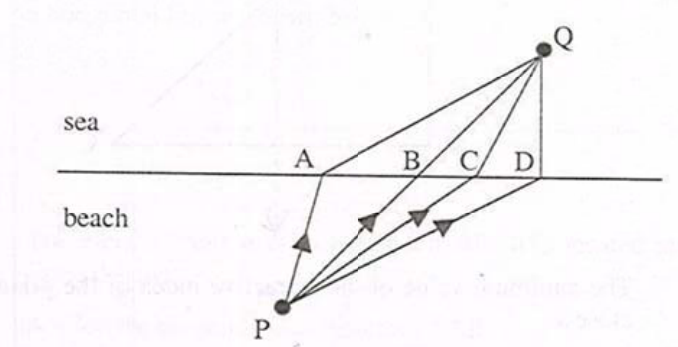
A girl standing at point P on a beach wishes to reach a point Q in the sea as quickly as possible. She can run at kmh on the beach and swim at kmh in the sea. She should take the path
From KVPY 2011 · Stream SA
A girl standing at point P on a beach wishes to reach a point Q in the sea as quickly as possible. She can run at kmh on the beach and swim at kmh in the sea. She should take the path
Worked solution
This is Fermat's principle in disguise. Minimising the travel time across two media gives exactly the refraction law
with measured from the normal to the shoreline, on the beach and in the sea.
What that implies.
so : she should slant more while running and enter the water on a path closer to the normal, spending as much of the journey as possible in the faster medium.
Locate the entry point. A straight line from P to Q would make the two angles equal. To make the larger one she must move the entry point towards D (the foot of the perpendicular from Q), but not all the way to D: at D the swim would be exactly along the normal, , which would require as well.
The entry point therefore lies between the straight-line crossing and D: the point C.
(C)
Every past question tagged to the same part of the syllabus, with solutions.
Timed, in the real format, and marked the moment you submit.