Skip to content
dronacharya.ai
KVPY 2011PhysicsSingle correct+1 / -0.25

Physics, question 16

From KVPY 2011 · Stream SA

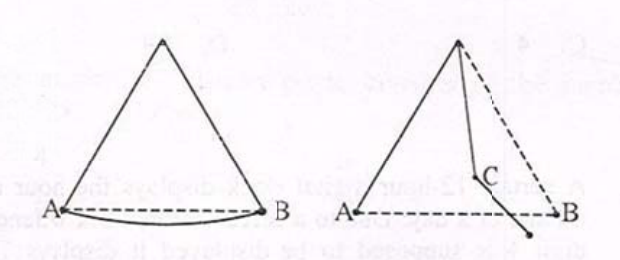
A simple pendulum oscillates freely between points A and B.

We now put a peg (nail) at some point C as shown. As the pendulum moves from A to the right, the string will bend at C and the pendulum will go to its extreme point D. Ignoring friction, the point D

Two sketches of the same pendulum side by side. In the left sketch the string hangs from a fixed point at the top and the bob swings between A at the lower left and B at the lower right, with a dashed horizontal line joining A and B. In the right sketch a peg C is marked on the string partway down on the right-hand side, so that the swing to the right pivots about C; the string beyond the peg is drawn dashed and the dashed line AB is again shown.
Choose one option
Answer and worked solutionTry it first, then open this to check your working.
Official answerA

Worked solution

Energy is the only thing that matters. Friction is ignored and the string's tension does no work, so the bob's mechanical energy is conserved throughout the swing: including the moment the string catches on the peg.

A and B are at the same height. They are the two ends of the free swing, so the bob is momentarily at rest at each, and both lie at the same height above the lowest point.

Where D must be. Released from rest at A, the bob again comes to rest when it has climbed back to the same height. The peg shortens the radius, so D is nearer the peg and the arc is tighter, but the height is unchanged.

So D lies on the horizontal line AB. (It is not B itself, because the shorter radius means a larger angular swing.)

(A)
Practise this topic

Every past question tagged to the same part of the syllabus, with solutions.

full papers
153
questions
13,073
worked solutions
13,054

Sit a paper tonight. See exactly where you stand.

Timed, in the real format, and marked the moment you submit.