Skip to content
dronacharya.ai
KVPY 2011ChemistrySingle correct+2 / -0.5

Chemistry, question 73

From KVPY 2011 · Stream SA

In the following reaction sequence, X and Y, respectively, are
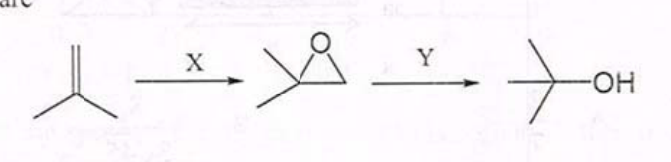
A three-step scheme drawn left to right. The starting material is 2-methylpropene, drawn as a skeletal structure with a carbon-carbon double bond and two methyl groups on one end. An arrow labelled X leads to an epoxide, the same skeleton with a three-membered ring containing an oxygen at the former double bond. A second arrow labelled Y leads to a tertiary alcohol, a carbon bearing three methyl groups and an OH.
Choose one option
Answer and worked solutionTry it first, then open this to check your working.
Official answerB

Worked solution

Read the scheme. 2-Methylpropene →\to 2,2-dimethyloxirane →\to tert-butyl alcohol.

Step X: making the epoxide. Converting an alkene directly to an epoxide is the job of a peroxyacid; perbenzoic acid, CX6HX5COOOH\ce{C6H5COOOH}, delivers one oxygen atom across the double bond in a single concerted step.
(CHX3)X2C=CHX2→CX6HX5COOOH(CHX3)X2C(−O−)CHX2\ce{(CH3)2C=CH2 ->[C6H5COOOH] (CH3)2C(-O-)CH2}
(HX2OX2\ce{H2O2} alone will not epoxidise a simple alkene, and alkaline KMnOX4\ce{KMnO4} would give the syn-diol instead.)

Step Y: opening it to the tertiary alcohol. LiAlHX4\ce{LiAlH4} supplies hydride, which attacks the less hindered carbon of the epoxide (CHX2\ce{CH2}), so the oxygen is left on the more substituted carbon:
(CHX3)X2C(−O−)CHX2→LiAlHX4(CHX3)X3C−OH\ce{(CH3)2C(-O-)CH2 ->[LiAlH4] (CH3)3C-OH}
Zn/Hg with HCl (Clemmensen) reduces carbonyls, not epoxides, so it cannot be Y.

(B)

Practise this topic

Every past question tagged to the same part of the syllabus, with solutions.

full papers
153
questions
13,073
worked solutions
13,054

Sit a paper tonight. See exactly where you stand.

Timed, in the real format, and marked the moment you submit.