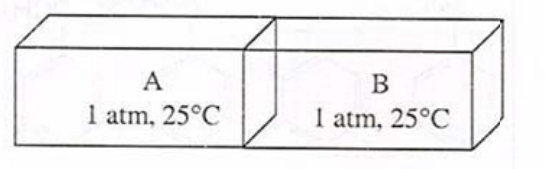
An isolated box, equally partitioned contains two ideal gases A and B as shown
When the partition is removed, the gases mix. The changes in enthalpy (H) and entropy (S) in the process, respectively, are
From KVPY 2011 · Stream SA
An isolated box, equally partitioned contains two ideal gases A and B as shown
When the partition is removed, the gases mix. The changes in enthalpy (H) and entropy (S) in the process, respectively, are
Worked solution
Enthalpy. The gases are ideal, so there are no intermolecular forces and no energy is absorbed or released when the molecules intermingle at constant temperature:
Entropy. Each gas, previously confined to half the box, now has the whole box available. Spreading into a larger volume increases the number of accessible microstates:
Mixing is spontaneous and irreversible, driven entirely by the entropy term: .
So is zero and is positive.
(A)
Every past question tagged to the same part of the syllabus, with solutions.
Timed, in the real format, and marked the moment you submit.