Skip to content
dronacharya.ai
KVPY 2010PhysicsSingle correct+1 / -0.25

Physics, question 15

From KVPY 2010 · Stream SA

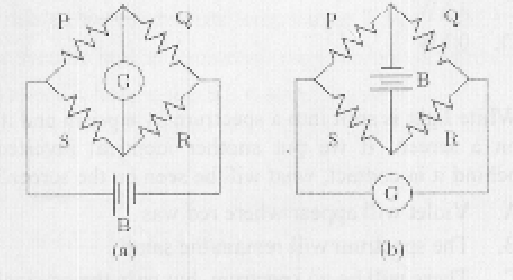
Figure (a) below shows a Wheatstone bridge in which PP, QQ, RR, SS are fixed resistances, GG is a galvanometer and BB is a battery. For this particular case the galvanometer shows zero deflection. Now, only the positions of BB and GG are interchanged, as shown in figure (b). The new deflection of the galvanometer

Two Wheatstone bridge networks drawn side by side as diamonds, labelled (a) and (b). In each the four arms carry the resistances P (upper left), Q (upper right), S (lower left) and R (lower right). In figure (a) the galvanometer G sits in the horizontal bridge arm between the left and right corners and the battery B is connected across the vertical diagonal, at the bottom. In figure (b) the two are interchanged: the battery B sits in the horizontal bridge arm between the left and right corners and the galvanometer G is connected at the bottom of the vertical diagonal.
Choose one option
Answer and worked solutionTry it first, then open this to check your working.
Official answerC

Worked solution

The balance condition. In figure (a) the galvanometer reads zero, so the bridge is balanced:
PQ=SR,i.e.PR=QS.\frac{P}{Q} = \frac{S}{R}, \qquad \text{i.e.}\qquad PR = QS .

Why swapping does nothing. That condition says the potential at the two bridge corners is the same when the battery drives current through the four arms. It is symmetric between the two diagonals: the same relation PR=QSPR = QS makes the other diagonal an equipotential pair when the battery is moved to the first diagonal. Interchanging the battery and the galvanometer therefore leaves a balanced bridge balanced.

The galvanometer still reads zero.

(C)
Practise this topic

Every past question tagged to the same part of the syllabus, with solutions.

full papers
153
questions
13,073
worked solutions
13,054

Sit a paper tonight. See exactly where you stand.

Timed, in the real format, and marked the moment you submit.