Skip to content
dronacharya.ai
← JEE Main 2026 · 2 Apr · Shift 2
ChemistrySingle correct+4 / -1Question 57 of 75

JEE Main 2026 · 2 Apr · Shift 2, Chemistry question 57

Consider the reaction a X→b Y\ce{aX -> bY}, for which the rate constant at 30 °C is 1×10⁻³¹\times10^{-3} mol−1^{-1} L s−1^{-1}. Which of the following statements are true ?

A. When concentration of 'X' is increased to four times, the rate of reaction becomes 16 times.

B. The reaction is a second order reaction.

C. The half-life period is independent of the concentration of X.

D. Decomposition of NX2OX5\ce{N2O5} is an example of the above reaction.

E. The graph of ln⁡[R0][R]\ln\dfrac{[R_0]}{[R]} against time shown is valid for the above reaction.

Choose the correct answer from the options given below :
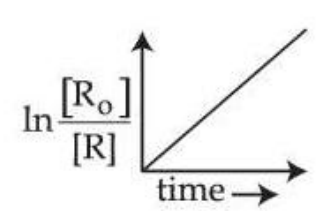
Statement E's graph: ln([R₀]/[R]) on the vertical axis against time, a straight line rising from the origin.
Choose one option
Answer and worked solution

Official answer: A

Order from units. mol⁻¹ L s⁻¹ means second order (B ✓).

  • A ✓: rate ∝ [X]2[X]^2, so 4× concentration gives 16× rate.
  • C ✗: for second order, t1/2=1k[X]0t_{1/2}=\frac1{k[X]_0} depends on concentration.
  • D ✗: NX2OX5\ce{N2O5} decomposition is first order.
  • E ✗: a linear ln⁡[R0][R]\ln\frac{[R_0]}{[R]} vs t plot is first-order behaviour.

A and B only.

(A)