Skip to content
dronacharya.ai
JEE Main 2020PhysicsSingle correct+4 / -1

Physics, question 13

From JEE Main 2020 · 9 Jan · Shift 1

A charged particle of mass 'm' and charge 'q' moving under the influence of uniform electric field Ei^E\hat i and a uniform magnetic field Bk^B\hat k follows a trajectory from point P to Q as shown in figure. The velocities at P and Q are respectively, vi^v\hat i and −2vj^-2v\hat j. Then which of the following statements (A, B, C, D) are the correct ? (Trajectory shown is schematic and not to scale)

(A) E=34(mv2qa)E=\dfrac34\left(\dfrac{mv^2}{qa}\right)

(B) Rate of work done by the electric field at P is 34(mv3a)\dfrac34\left(\dfrac{mv^3}a\right)

(C) Rate of work done by both the fields at Q is zero

(D) The difference between the magnitude of angular momentum of the particle at P and Q is 2 mav.
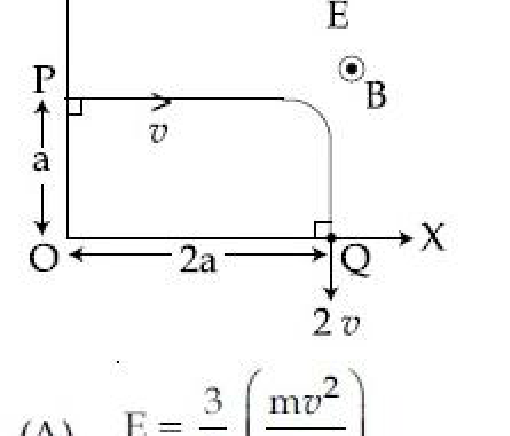
Axes with origin O: P at (0, a) on the y-axis with velocity v along +x; the path runs right and curves down to Q at (2a, 0) on the x-axis, where the velocity is 2v along −y. E points along x, and B points out of the page.
Choose one option
Answer and worked solutionTry it first, then open this to check your working.
Official answerD

Worked solution

Only E does work (B does none).

  • (A) P to Q moves 2a2a along x: qE(2a)=12m(4v2−v2)qE(2a)=\frac12m(4v^2-v^2), so E=3mv24qaE=\dfrac{3mv^2}{4qa}. True.
  • (B) At P, v⃗∥E⃗\vec v\parallel\vec E: power =qEv=34mv3a=qEv=\dfrac34\dfrac{mv^3}a. True.
  • (C) At Q, v⃗=−2vj^⊥E⃗\vec v=-2v\hat j\perp\vec E, and the magnetic force never does work: zero. True.
  • (D) About O: ∣LP∣=mva|L_P|=m v a (P at (0,a)(0,a)), ∣LQ∣=m(2v)(2a)=4mav|L_Q|=m(2v)(2a)=4mav. The difference is 3mav3mav, not 2mav2mav. False.

(D)

Practise this topic

Every past question tagged to the same part of the syllabus, with solutions.

full papers
153
questions
13,073
worked solutions
13,054

Sit a paper tonight. See exactly where you stand.

Timed, in the real format, and marked the moment you submit.