Skip to content
dronacharya.ai
← JEE Advanced 2026 · Paper 2
PhysicsNumerical+4Question 30 of 54

JEE Advanced 2026 · Paper 2, Physics question 12

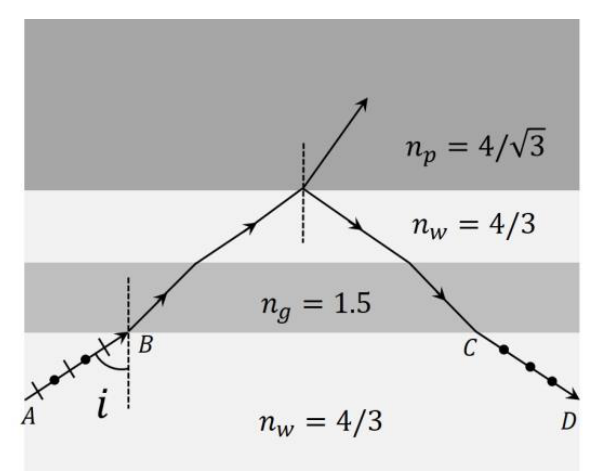
As shown in the figure, a ray ABAB of unpolarized light enters from water of refractive index nw=4/3n_w=4/3 into a medium of refractive index np=4/3n_p=4/\sqrt3 after passing through a glass plate of refractive index ng=1.5n_g=1.5 and a layer of water. At a particular incident angle ii the reflected ray CDCD is polarized in the direction as shown in the figure. The value of ii (in degrees) is:

Horizontal layers, bottom to top: water (n_w = 4/3), a glass plate (n_g = 1.5), a water layer (n_w = 4/3) and a medium n_p = 4/√3. Ray AB rises from the bottom water at incidence i, refracts through the glass and water layers and meets the n_p boundary; part is transmitted upward, and the reflected part returns down through the layers as CD. AB carries both dots and bars (unpolarized); CD carries only dots (polarized perpendicular to the plane of the figure).
Answer and worked solution

Official answer: 60

The reflected ray CDCD has only the component perpendicular to the plane of incidence. So the reflection at the water-npn_p boundary is at Brewster's angle:
tan⁡θB=npnw=4/34/3=3  ⟹  θB=60∘.\tan\theta_B=\frac{n_p}{n_w}=\frac{4/\sqrt3}{4/3}=\sqrt3\implies\theta_B=60^\circ.
The layers are parallel, so nsin⁡(angle)n\sin(\text{angle}) is the same in every layer. The bottom medium is also water, so
nwsin⁡i=nwsin⁡60∘  ⟹  i=60∘.n_w\sin i=n_w\sin60^\circ\implies i=60^\circ.