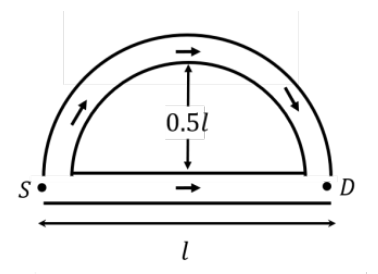
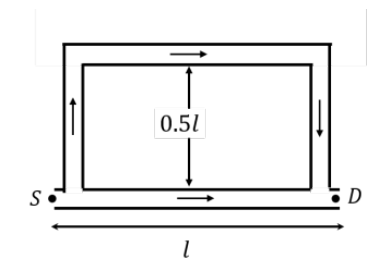
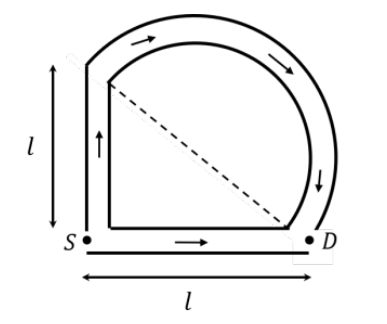
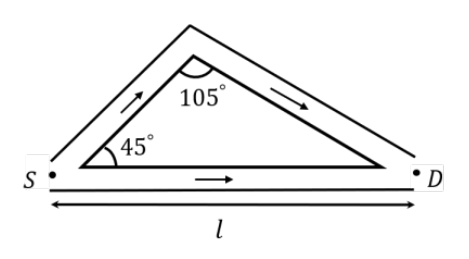
List-I shows four configurations made of straight and semi-circular narrow tubes containing air. A sound wave of wavelength λ=0.29 m enters these structures at the point S and a sound detector is placed at D. Between the points S and D, the sound travels only through the tubes. List-II contains the possible smallest values of l (refer to the figures) for which the detector D records maximum amplitude. Ignore effects of sharp corners. [Given cos(15∘)=0.97]
Choose the option that best describes the match between the entries in List-I to those in List-II.
List-I
P
Q
R
S
List-II
1
1.32 m
2
1.19 m
3
0.51 m
4
0.29 m
5
0.13 m
Answer and worked solution
Official answer: D
D records a maximum when the two paths differ by a whole number of wavelengths. The smallest l uses a difference of λ=0.29 m.
(P) Semicircle of diameter l: length 2πl. Difference (2π−1)l=0.571l, so l=0.51 m → 3.
(Q) Detour 0.5l+l+0.5l=2l. Difference l, so l=0.29 m → 4.
(R) Up l, then a semicircle whose diameter is the diagonal 2l: length l+2π2l=3.221l. Difference 2.221l, so l=0.13 m → 5.
(S) A triangle on base l with angles 45∘, 30∘ and 105∘. By the sine rule the other sides are sin105∘sin45∘l and sin105∘sin30∘l. With sin105∘=cos15∘=0.97 their sum is 1.245l. Difference 0.245l, so l=1.19 m → 2.