Consider a large disk of radius and two smaller disks, each of radius , lying on its circumference, as shown in the figure. The smaller disks are initially in contact with each other, with an angular separation between their centers. They are made to roll without slipping in opposite directions, with constant angular velocities and while the large disk is held stationary. The time at which the smaller disks are again in contact is:
[Use and ignore gravity.]
← JEE Advanced 2026 · Paper 1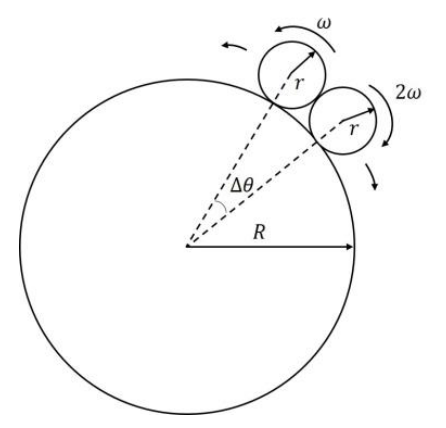
PhysicsSingle correct+3 / -1Question 17 of 48
JEE Advanced 2026 · Paper 1, Physics question 1
Answer and worked solution
Official answer: C
Orbital speed of each small disk. A disk rolling without slipping on the fixed rim has its centre moving with speed on a circle of radius . Its centre therefore turns about at
So the two centres turn at and , in opposite directions: relative rate .
Initial separation. Touching disks have centres apart: , so .
Meeting again. They move apart and meet on the other side once their angular gap, the long way round, shrinks back to . The relative angle covered is , so