An audio transmitter (T) and a receiver (R) are hung vertically from two identical massless strings of length 8 m with their pivots well separated along the axis. They are pulled from the equilibrium position in opposite directions along the axis by a small angular amplitude and released simultaneously. If the natural frequency of the transmitter is 660 Hz and the speed of sound in air is 330 m/s, the maximum variation in the frequency (in Hz) as measured by the receiver (Take the acceleration due to gravity ) is _____.
← JEE Advanced 2025 · Paper 2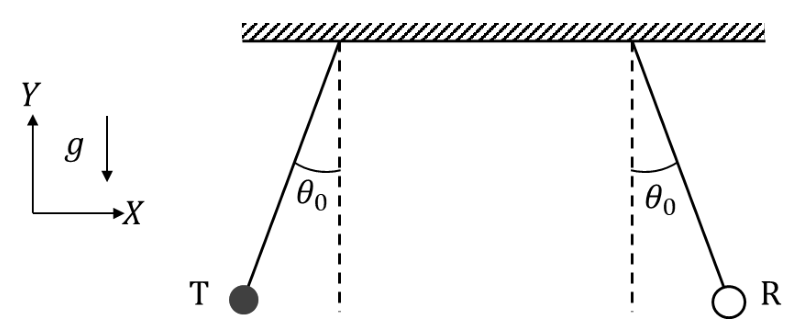
PhysicsNumerical+4Question 32 of 48
JEE Advanced 2025 · Paper 2, Physics question 16
Answer and worked solution
Official answer: 26
Maximum speed of each pendulum.
The two swing as mirror images, so at the bottom they move directly towards or away from each other, each at 4 m/s.
Doppler extremes.
- Approaching: Hz.
- Receding: Hz.
Maximum variation. Hz.