In a Young's double slit experiment, a combination of two glass wedges and , having refractive indices 1.7 and 1.5, respectively, are placed in front of the slits, as shown in the figure. The separation between the slits is mm and the shortest distance between the slits and the screen is m. Thickness of the combination of the wedges is m. The value of as shown in the figure is 1 mm. Neglect any refraction effect at the slanted interface of the wedges. Due to the combination of the wedges, the central maximum shifts (in mm) with respect to O by _____.
← JEE Advanced 2025 · Paper 2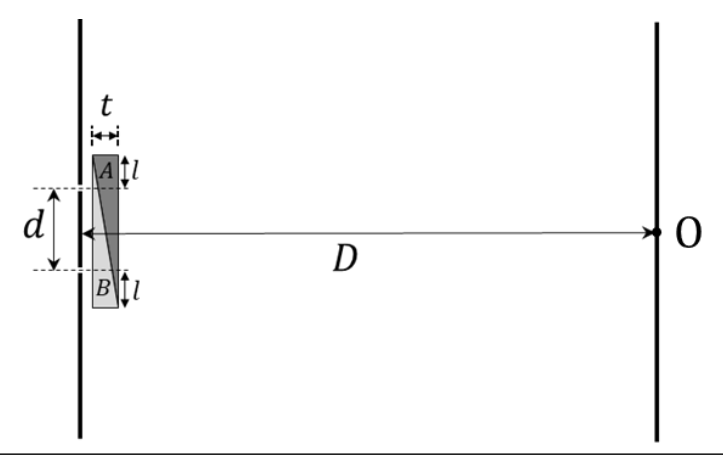
PhysicsNumerical+4Question 30 of 48
JEE Advanced 2025 · Paper 2, Physics question 14
Answer and worked solution
Official answer: 1.2
Wedge thicknesses at each slit. The combination is a slab of thickness and height mm. Wedge A's thickness falls linearly from at the top to 0 at the bottom.
- Upper slit (1 mm from the top): A , B .
- Lower slit: A , B .
Optical path difference.
Shift of the central maximum.
It shifts towards the upper slit, which has the longer optical path.