For the reaction sequence given below, the correct statement(s) is(are)
← JEE Advanced 2025 · Paper 2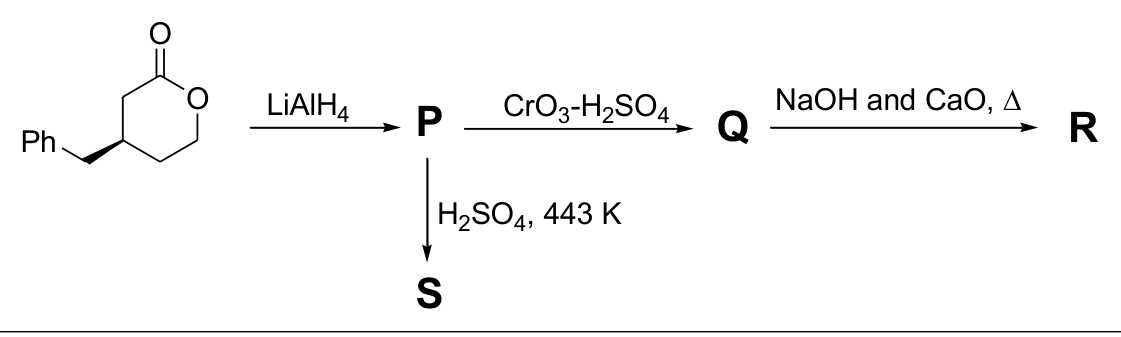
ChemistryMultiple correct+4 / -2Question 40 of 48
JEE Advanced 2025 · Paper 2, Chemistry question 8
Answer and worked solution
Official answer: B, C
The compounds. The lactone is 4-benzyltetrahydropyran-2-one.
- P: opens it to the diol (3-benzylpentane-1,5-diol).
- Q: Jones oxidation gives 3-benzylpentanedioic acid.
- R: Soda-lime decarboxylation removes both groups, giving .
- S: Dehydrating P with acid gives unsaturated products.
Options.
- (A) False. C3 of P carries two identical arms, so P is achiral and optically inactive.
- (B) True. S contains C=C, so it decolourises Baeyer's reagent.
- (C) True. Q is a dicarboxylic acid, so it releases with .
- (D) False. R is an alkane (isobutylbenzene), not an alkyne.