Skip to content
dronacharya.ai
← JEE Advanced 2024 · Paper 2
PhysicsNumerical+3Question 34 of 51

JEE Advanced 2024 · Paper 2, Physics question 17

Passage

PARAGRAPH II

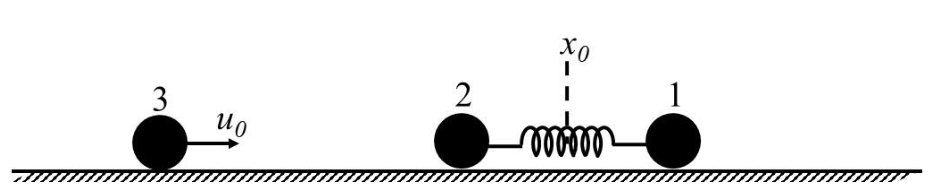
Two particles, 1 and 2, each of mass mm, are connected by a massless spring, and are on a horizontal frictionless plane, as shown in the figure. Initially, the two particles, with their center of mass at x0x_0, are oscillating with amplitude aa and angular frequency ω\omega. Thus, their positions at time tt are given by x1(t)=(x0+d)+asin⁡ωtx_1(t) = (x_0 + d) + a\sin\omega t and x2(t)=(x0−d)−asin⁡ωtx_2(t) = (x_0 - d) - a\sin\omega t, respectively, where d>2ad > 2a. Particle 3 of mass mm moves towards this system with speed u0=aω/2u_0 = a\omega/2, and undergoes instantaneous elastic collision with particle 2, at time t0t_0. Finally, particles 1 and 2 acquire a center of mass speed vcmv_{\text{cm}} and oscillate with amplitude bb and the same angular frequency ω\omega.

On a horizontal frictionless surface: particle 3 on the left moving right with speed u₀ toward particle 2; particles 2 (left) and 1 (right) are joined by a spring, and the dashed mark x₀ above the spring shows their centre of mass.

If the collision occurs at time t0=π/(2ω)t_0 = \pi/(2\omega), then the value of 4b2/a24b^2/a^2 will be _____.

Answer and worked solution

Official answer: 4.2

State at the collision. At t0=π2ωt_0=\frac{\pi}{2\omega} both particles are momentarily at rest and at maximum stretch:

  • particle 1 is at x0+d+ax_0+d+a;
  • particle 2 is at x0−d−ax_0-d-a.

Particle 2 takes particle 3's velocity aω2\frac{a\omega}{2}, so vcm=aω4v_{cm}=\frac{a\omega}{4}.

In the centre-of-mass frame. Each particle is displaced aa from its equilibrium position and moves at aω4\frac{a\omega}{4}. It oscillates at the same ω\omega, so
b2=a2+(aω/4ω)2=1716a2  ⟹  4b2a2=174=4.25.b^2=a^2+\left(\frac{a\omega/4}{\omega}\right)^2=\frac{17}{16}a^2\implies\frac{4b^2}{a^2}=\frac{17}{4}=4.25.