Skip to content
dronacharya.ai
← JEE Advanced 2024 · Paper 1
ChemistryList match+3 / -1Question 48 of 51

JEE Advanced 2024 · Paper 1, Chemistry question 14

In a conductometric titration, small volume of titrant of higher concentration is added stepwise to a larger volume of titrate of much lower concentration, and the conductance is measured after each addition.

The limiting ionic conductivity (Λ0\Lambda_0) values (in mS m2 mol−1\mathrm{mS\,m^2\,mol^{-1}}) for different ions in aqueous solutions are given below:

Ions AgX+\ce{Ag+} KX+\ce{K+} NaX+\ce{Na+} HX+\ce{H+} NOX3X−\ce{NO3-} ClX−\ce{Cl-} SOX4X2−\ce{SO4^2-} OHX−\ce{OH-} CHX3COOX−\ce{CH3COO-}
Λ0\Lambda_0 6.2 7.4 5.0 35.0 7.2 7.6 16.0 19.9 4.1

For different combinations of titrates and titrants given in List-I, the graphs of 'conductance' versus 'volume of titrant' are given in List-II.

Match each entry in List-I with the appropriate entry in List-II and choose the correct option.
List-I

  • P
    Titrate: KCl\ce{KCl}; Titrant: AgNOX3\ce{AgNO3}
  • Q
    Titrate: AgNOX3\ce{AgNO3}; Titrant: KCl\ce{KCl}
  • R
    Titrate: NaOH\ce{NaOH}; Titrant: HCl\ce{HCl}
  • S
    Titrate: NaOH\ce{NaOH}; Titrant: CHX3COOH\ce{CH3COOH}

List-II

  • 1
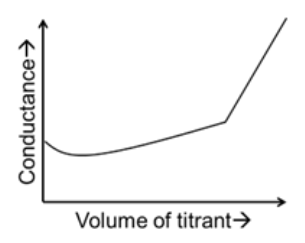
    Conductance vs volume of titrant: starts moderately high, dips slightly to a shallow minimum early on, then rises slowly and almost linearly, and after a break point rises steeply.
  • 2
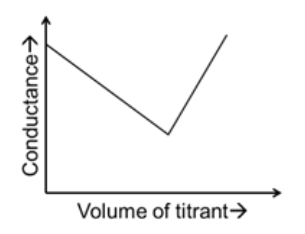
    Conductance vs volume of titrant: starts high and decreases linearly and steeply to a sharp minimum (V-shape), then increases steeply after the end point.
  • 3
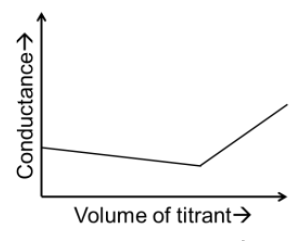
    Conductance vs volume of titrant: starts at a low-moderate value and decreases very slightly (almost flat) up to the end point, then increases linearly with a moderate slope.
  • 4
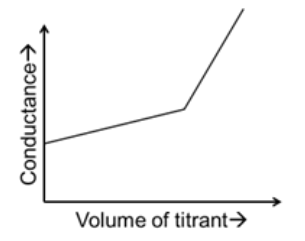
    Conductance vs volume of titrant: starts at a low-moderate value and increases slowly and linearly up to the end point, then increases steeply.
  • 5
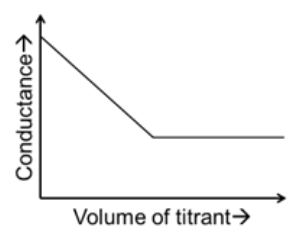
    Conductance vs volume of titrant: starts high and decreases linearly to the end point, after which it stays constant (horizontal line).
Choose one option
Answer and worked solution

Official answer: C

Concentrated titrant means dilution can be ignored; conductance follows the ions present.

  • (P) KCl titrated with AgNOX3\ce{AgNO3}: AgCl\ce{AgCl} precipitates and ClX−\ce{Cl-} (7.6) is replaced by NOX3X−\ce{NO3-} (7.2), so conductance falls slightly. After the end point, excess AgX+\ce{Ag+} and NOX3X−\ce{NO3-} make it rise. → (3)
  • (Q) AgNOX3\ce{AgNO3} titrated with KCl: AgX+\ce{Ag+} (6.2) is replaced by KX+\ce{K+} (7.4), a slow rise; after the end point, excess KX+\ce{K+} and ClX−\ce{Cl-} give a steeper rise. → (4)
  • (R) NaOH titrated with HCl: OHX−\ce{OH-} (19.9) is replaced by ClX−\ce{Cl-} (7.6), a sharp fall; then excess HX+\ce{H+} (35.0) gives a sharp rise (V-shape). → (2)
  • (S) NaOH titrated with CHX3COOH\ce{CH3COOH}: OHX−\ce{OH-} is replaced by CHX3COOX−\ce{CH3COO-} (4.1), a fall; after the end point the weakly ionised acid barely adds ions, so it is flat. → (5)

Option (C).