Skip to content
dronacharya.ai
← JEE Advanced 2024 · Paper 1
ChemistryInteger+4Question 46 of 51

JEE Advanced 2024 · Paper 1, Chemistry question 12

In the following reaction sequence, the major product P is formed.

H−C≡C−(CHX2)X15−COX2Et→ii) Zn-Hg/HCl; iii)  HX3OX+,Δi)  HgX2+,HX3OX+P\ce{H-C#C-(CH2)15-CO2Et ->[\text{i) } Hg^{2+}, H3O+][\text{ii) Zn-Hg/HCl; iii) } H3O+, \Delta] P}

Glycerol reacts completely with excess P in the presence of an acid catalyst to form Q. Reaction of Q with excess NaOH followed by the treatment with CaClX2\ce{CaCl2} yields Ca-soap R, quantitatively. Starting with one mole of Q, the amount of R produced in gram is _____.

[Given, atomic weight: H = 1, C = 12, N = 14, O = 16, Na = 23, Cl = 35, Ca = 40]
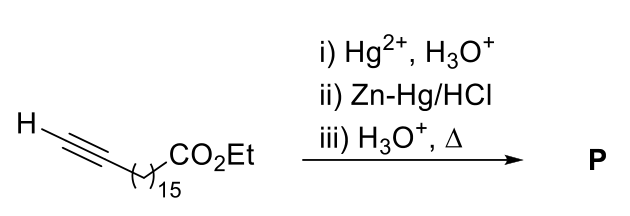
Reaction scheme: ethyl ester of a terminal alkyne, H-C≡C-(CH₂)₁₅-CO₂Et (the (CH₂) unit in brackets with subscript 15), reacts with i) Hg²⁺, H₃O⁺; ii) Zn-Hg/HCl; iii) H₃O⁺, Δ (reagents written above the arrow) to give P.
Answer and worked solution

Official answer: 909

Steps:

  1. HgX2+/HX3OX+\ce{Hg^2+/H3O+} hydrates the terminal alkyne to a methyl ketone, CHX3CO(CHX2)X15COX2Et\ce{CH3CO(CH2)15CO2Et}.
  2. Clemmensen reduction gives CHX3CHX2(CHX2)X15COX2Et\ce{CH3CH2(CH2)15CO2Et}.
  3. HX3OX+\ce{H3O+}, Δ\Delta hydrolyses the ester to stearic acid, CX17HX35COOH\ce{C17H35COOH} (P, 18 carbons).

Q is glyceryl tristearate. Saponification of 1 mol Q gives 3 mol CX17HX35COOX−\ce{C17H35COO-}, and CaClX2\ce{CaCl2} precipitates (CX17HX35COO)X2Ca\ce{(C17H35COO)2Ca}: 1.5 mol.

Molar mass: CX17HX35COOX−=216+35+32=283\ce{C17H35COO-} = 216 + 35 + 32 = 283, so the salt is 40+2×283=606 g mol−140 + 2\times283 = 606\,\mathrm{g\,mol^{-1}}.

Mass =1.5×606=909 g= 1.5\times606 = 909\,\mathrm{g}.