Skip to content
dronacharya.ai
← JEE Advanced 2023 · Paper 2
PhysicsSingle correct+3 / -1Question 18 of 51

JEE Advanced 2023 · Paper 2, Physics question 1

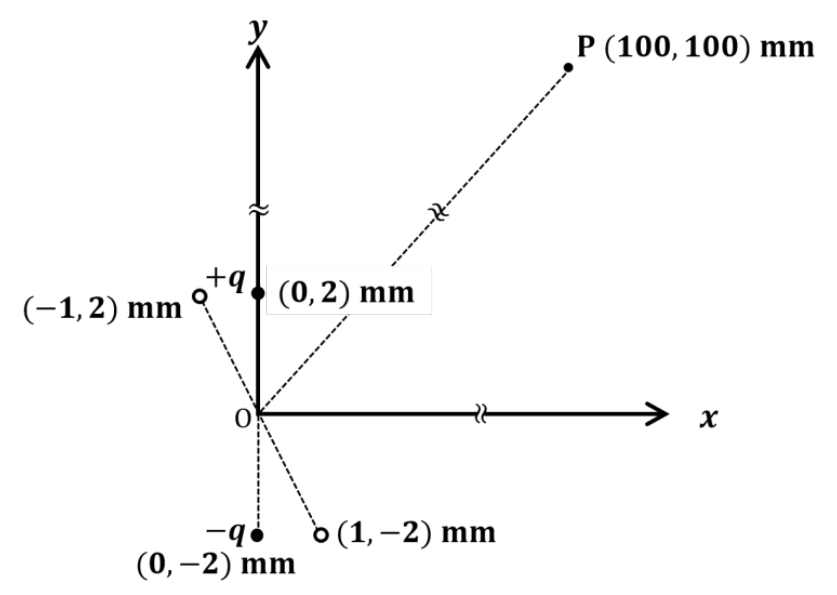
An electric dipole is formed by two charges +q+q and −q-q located in xyxy-plane at (0,2)(0,2) mm and (0,−2)(0,-2) mm, respectively, as shown in the figure. The electric potential at point P (100,100)(100,100) mm due to the dipole is V0V_0. The charges +q+q and −q-q are then moved to the points (−1,2)(-1,2) mm and (1,−2)(1,-2) mm, respectively. What is the value of electric potential at P due to the new dipole?

xy axes with origin O. Charge +q at (0, 2) mm and -q at (0, -2) mm on the y-axis (filled dots). Open circles mark the new positions (-1, 2) mm and (1, -2) mm, joined by a dashed line through O. Point P at (100, 100) mm is far away along the 45-degree direction, with a dashed line from O (axes and line broken to show the distance is not to scale).
Choose one option
Answer and worked solution

Official answer: B

P is far away (r≈141r\approx141 mm ≫4\gg4 mm), so the dipole approximation applies:
V=k p⃗⋅r^r2,r^=12(1,1).V=\frac{k\,\vec p\cdot\hat r}{r^2},\qquad\hat r=\tfrac1{\sqrt2}(1,1).

Dipole moments (p⃗=q(r⃗+−r⃗−)\vec p=q(\vec r_+-\vec r_-), in units of q⋅q\cdotmm):

  • original: (0,4)(0,4), so p⃗⋅r^=42\vec p\cdot\hat r=\frac4{\sqrt2};
  • new: (−1,2)−(1,−2)=(−2,4)(-1,2)-(1,-2)=(-2,4), so p⃗⋅r^=22\vec p\cdot\hat r=\frac2{\sqrt2}.

Both dipoles are centred at O, so rr is unchanged. The potential halves: V=V0/2V=V_0/2.