A slide with a frictionless curved surface, which becomes horizontal at its lower end, is fixed on the terrace of a building of height from the ground, as shown in the figure. A spherical ball of mass is released on the slide from rest at a height from the top of the terrace. The ball leaves the slide with a velocity and falls on the ground at a distance from the building making an angle with the horizontal. It bounces off with a velocity and reaches a maximum height . The acceleration due to gravity is and the coefficient of restitution of the ground is . Which of the following statement(s) is(are) correct?
← JEE Advanced 2023 · Paper 1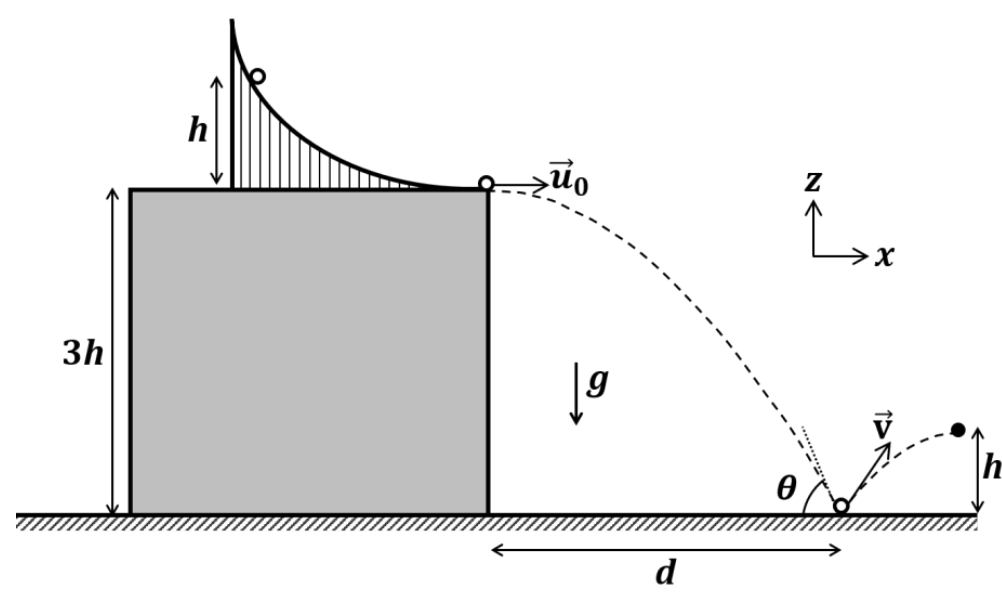
PhysicsMultiple correct+4 / -2Question 18 of 51
JEE Advanced 2023 · Paper 1, Physics question 1
Answer and worked solution
Official answer: A, C, D
Leaving the slide. The slide is frictionless, so and . (A) true.
Landing. The ball falls :
- vertical speed ;
- time of flight .
So , giving . (C) true.
Bounce. The vertical component becomes , upward; the horizontal component is unchanged. So
(B) false: the component is upward, not downward.
Ratio.
- ;
- .
So . (D) true.