Skip to content
dronacharya.ai
← JEE Advanced 2021 · Paper 1
PhysicsMultiple correct+4 / -2Question 15 of 57

JEE Advanced 2021 · Paper 1, Physics question 15

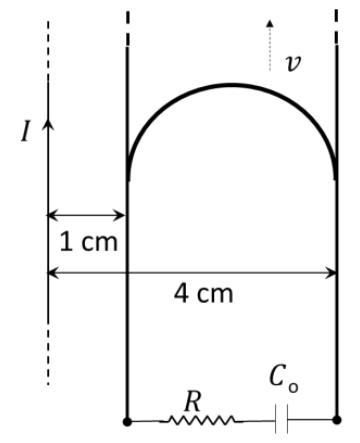
A long straight wire carries a current, I=2I = 2 ampere. A semi-circular conducting rod is placed beside it on two conducting parallel rails of negligible resistance. Both the rails are parallel to the wire. The wire, the rod and the rails lie in the same horizontal plane, as shown in the figure. Two ends of the semi-circular rod are at distances 1 cm and 4 cm from the wire. At time t=0t = 0, the rod starts moving on the rails with a speed v=3.0v = 3.0 m/s (see the figure).

A resistor R=1.4 ΩR = 1.4\ \Omega and a capacitor Co=5.0 μC_o = 5.0\ \muF are connected in series between the rails. At time t=0t = 0, CoC_o is uncharged. Which of the following statement(s) is(are) correct? [μ0=4π×10−7\mu_0 = 4\pi \times 10^{-7} SI units. Take ln⁡2=0.7\ln 2 = 0.7]

Top view: a long straight wire (dashed, current I upward) on the left. Two parallel rails run alongside it, at 1 cm and 4 cm from the wire. A semicircular conducting rod bridges the rails (its ends on the rails, arching forward) and moves along them with speed v in the direction of the current. At the far end the rails are joined through a resistor R in series with a capacitor C_o.
Choose one or more options
Answer and worked solution

Official answer: A, C

Induced emf. The semicircle and the straight segment joining its ends enclose a fixed area, so they have the same motional emf. For a segment from r1=1r_1=1 cm to r2=4r_2=4 cm in the field μ0I2πr\frac{\mu_0I}{2\pi r}:
ε=∫r1r2μ0I2πrv dr=μ0Iv2πln⁡4=(2×10⁻⁷)(2)(3)(1.4)=1.68×10⁻⁶ V.\varepsilon=\int_{r_1}^{r_2}\frac{\mu_0I}{2\pi r}v\,dr=\frac{\mu_0Iv}{2\pi}\ln4=(2\times10^{-7})(2)(3)(1.4)=1.68\times10^{-6}\text{ V}.

RC circuit. The capacitor starts uncharged.

  • The current is largest at t=0t=0: imax=εR=1.68×10−61.4=1.2×10⁻⁶i_{max}=\dfrac\varepsilon R=\dfrac{1.68\times10^{-6}}{1.4}=1.2\times10^{-6} A. (A) is true.
  • The final charge is qmax=Cε=5×10−6×1.68×10−6=8.4×10⁻¹²q_{max}=C\varepsilon=5\times10^{-6}\times1.68\times10^{-6}=8.4\times10^{-12} C. (C) is true.

(A), (C)